


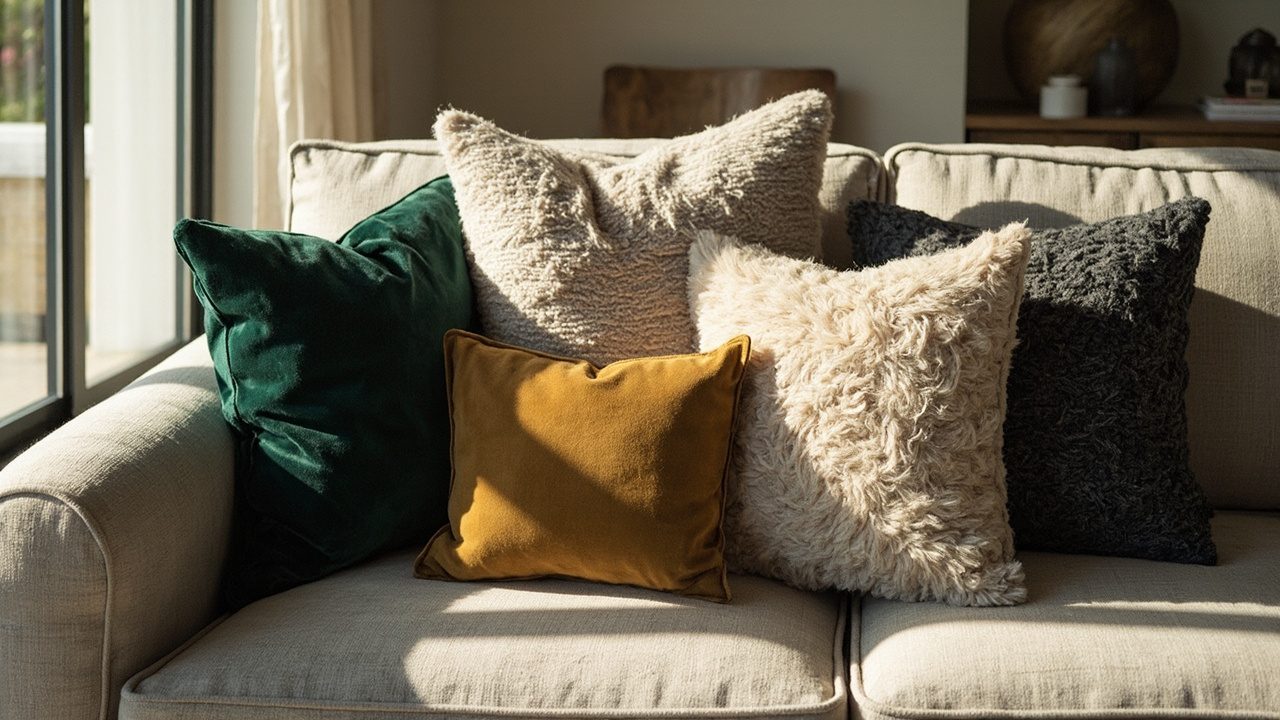
If you have been wondering how to style decorative pillows without creating a lumpy eyesore, start with a system, not a shopping spree.
In my experience, the best arrangements look effortless because every decision, from color story to scale, works hard together.
We will map your palette, nail the right counts per sofa, and layer patterns with intention, so your pillows feel curated and comfortably livable.
- Choose a cohesive color story first
- How many pillows per sofa size?
- Mixing patterns without visual chaos
- Pro tips for insert sizes and fills
- Arranging pillows by shape and height
- Balancing textures across seasons
- Budget swaps that still look designer
- Maintenance tricks to keep pillows crisp
- FAQ
- Final Thoughts
- Related Decor Reads
Choose a cohesive color story first
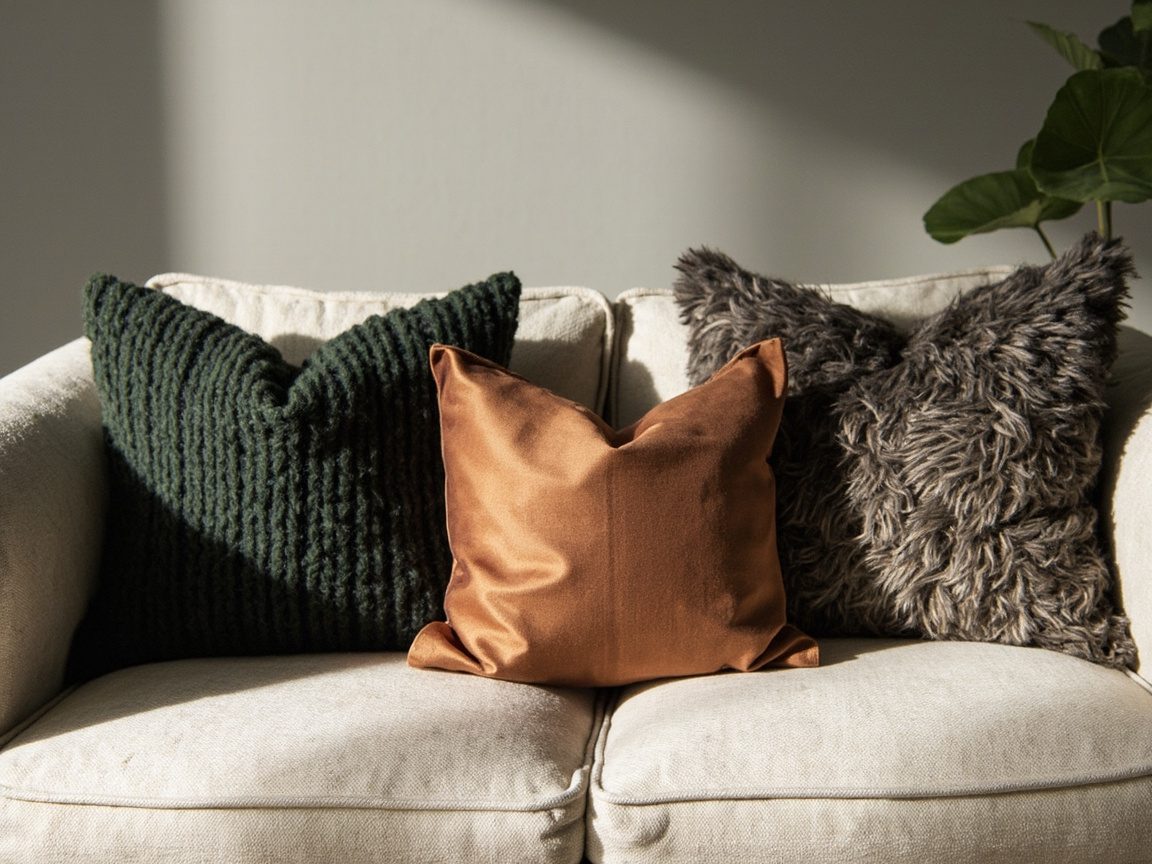
Start with fixed elements and one anchor
Your room already tells you what colors to use. Pull hues from immovable features like the sofa upholstery, rug, drapery, wood tone, or artwork.
I prefer one anchor color from the rug or art, one supporting neutral from the sofa, and one accent that adds temperature shift, for example, a cool blue against warm camel.
Build a 60, 30, 10 ratio
The most reliable mix follows 60 percent dominant, 30 percent secondary, and 10 percent accent. This prevents visual clutter and makes shopping straightforward.
When a client hands me a basket of random pillows, I re-sort by this ratio first, and the room calms instantly.
| Palette Role | Typical Colors | Quantity Guidance | Fabric Suggestions | Why It Works |
|---|---|---|---|---|
| 60% Dominant | Sofa color family or rug ground, e.g., oatmeal, charcoal | Half your pillows | Linen, textured cotton, subtle weave | Creates cohesion and supports bolder accents |
| 30% Secondary | Complement to dominant, e.g., olive, indigo, clay | About one third | Velvet, boucle, nubby wool | Adds depth with richer value or texture |
| 10% Accent | Contrast pop, e.g., saffron, verdigris, berry | One piece on a sofa, two on a sectional | Embroidered, patterned, or printed | Sets energy and focal point without overwhelm |
Undertones, seasons, and trend-proofing
Match undertones across materials. Warm beige pairs best with rust or olive, while cool gray sings with peacock or plum. If you like trend hues,
Keep them in the 10 percent slot, and rotate seasonally, which is exactly how I keep clients current without repurchasing a full set.
- Identify two fixed colors in your room, then choose one accent that is two to three steps brighter or darker.
- Keep prints inside your chosen palette. Do not add a new color just because it is on sale.
- Test covers at home in daylight and evening light before committing.
For farmhouse lovers, pull your dominant from natural textures, then layer a softened accent like faded indigo or thyme green.
See how this plays out in real homes in Modern Farmhouse Designs and Old Farmhouse features:
How many pillows per sofa size?
Right counts create rhythm, not clutter
Most mistakes happen here. Too few look cheap, too many feel fussy. I size the count to the length of the seating and adjust for seat depth, arm style, and how you actually sit.
| Sofa Type | Typical Length | Pillow Count | Recommended Sizes | Notes |
|---|---|---|---|---|
| Loveseat | 52 to 64 in | 2 to 3 | 2 x 20 in squares, optional 1 x 12×20 lumbar | Keep arms clear for sitting comfort |
| Standard Sofa | 72 to 84 in | 4 to 5 | 2 x 22 in, 2 x 20 in, optional 1 x 14×20 lumbar | Use a center lumbar if you prefer symmetry |
| Grand Sofa | 86 to 96 in | 5 to 7 | 2 x 24 in, 2 x 22 in, 1 to 3 accents incl. lumbar | Scale up to match deeper seats |
| Chaise Sofa | Varies | 3 to 4 | 1 x 24 in, 1 x 22 in, 1 to 2 accents | Concentrate on the chaise back and corner |
| L‑shaped Sectional | 96 to 120+ in | 6 to 9 | Corner: 24 in + 22 in layers, Ends: 22 in + 20 in, 1 to 2 accents | Anchor the corner, then mirror the ends |
Pro sizing rules I rely on
Increase pillow size as the seat gets deeper. A shallow 34-inch seat reads best with 20 to 22-inch squares, while a deep 40-inch seat needs 22 to 24-inch anchors to avoid looking like toys.
Always mix insert fills: down or down‑alternative in anchors for loft, firmer poly in lumbars for support.
- Use odd numbers for casual, even numbers for tailored symmetry.
- Leave at least 18 to 24 inches of open seating per person.
- Corner stacks get the largest pillow at the back, the smallest in front.
Common mistakes to avoid
Do not line up all pillows at identical heights. Step them down. Avoid five different sizes on a small sofa; it reads messy.
Finally, respect arm height: high track arms can take a larger anchor, and low slope arms need smaller pillows to keep proportions elegant.
Mixing patterns without visual chaos
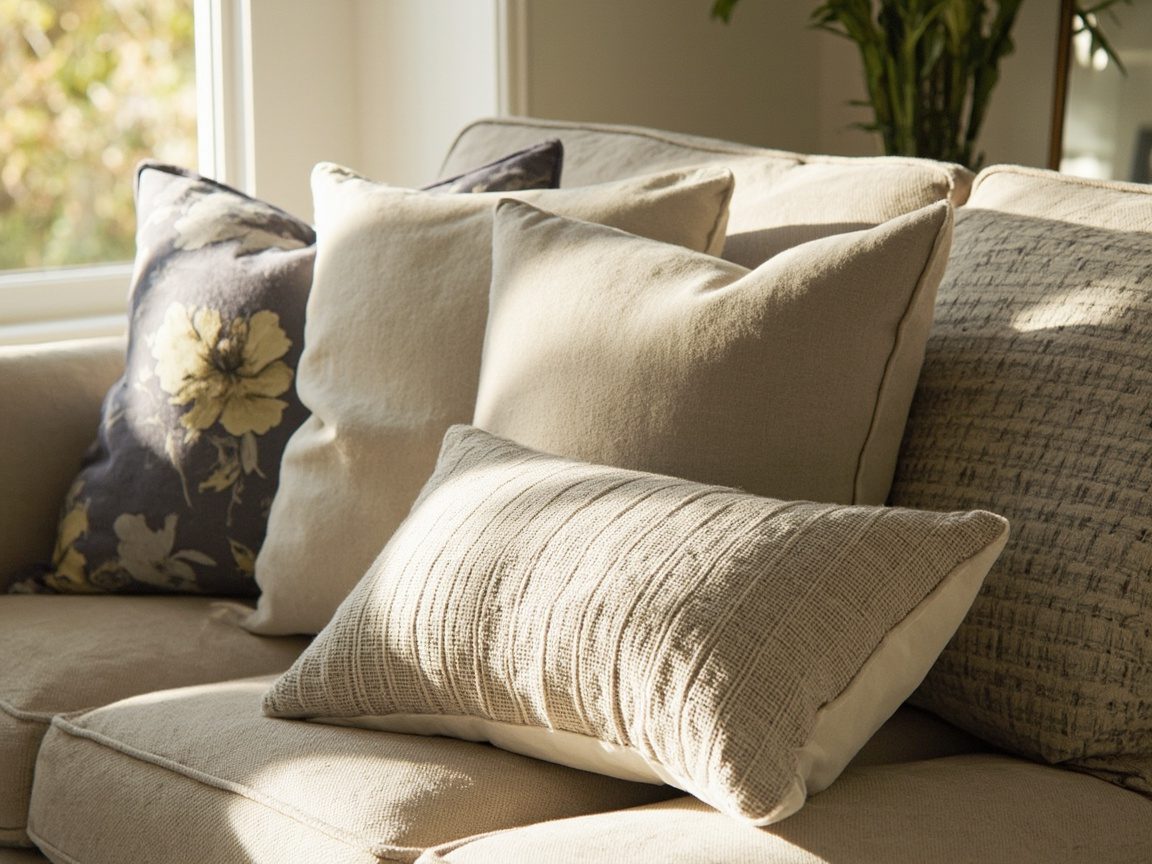
Set your hierarchy: hero, mixer, quiet
I always establish one hero pattern, one medium mixer, and one quiet texture. The hero carries scale and personality, like a large floral or bold stripe.
The mixer bridges colors in a tighter repeat, while the quiet piece grounds everything with texture instead of print.
| Creates a focal point and sets a palette | Scale | Examples | Best Placement | Why It Balances |
|---|---|---|---|---|
| Hero | Large scale | Botanical, wide stripe, painterly abstract | Center or sectional corner | Creates focal point and sets palette |
| Mixer | Medium scale | Geometrics, block prints, herringbone | Flanking the hero | Bridges colors, adds rhythm |
| Quiet | Small scale or solid with texture | Boucle, slub linen, micro check | Outermost positions and behind stacks | Rest for the eye, prevents clutter |
Contrast smartly across three axes
Great mixes depend on contrast in scale, motif, and texture. Pair organic motifs with structured geometrics, then add a tactile solid, for example, floral plus stripe plus velvet.
Keep all three within the same color story you established earlier, or everything falls apart.
- Limit new colors to what appears in the hero pattern.
- Vary line weight, for instance, chunky stripe with fine check.
- Repeat a color at least twice across different pillows for cohesion.
Editing and real‑world durability
Before finalizing, remove one piece. Negative space is a design tool. For family homes, put the most delicate embroidery in the least handled spot, usually the center, and use performance fabrics for the outer pillows where hands and pets land first.
Pro tips for insert sizes and fills
Size up your inserts for a tailored, full look
In my experience, the fastest way to make store-bought covers look custom is to size the insert up.
For square pillows, choose an insert 2 inches larger than the cover, for example, a 20-inch insert for an 18-inch cover, to eliminate corner collapse and rippling.
For lumbar pillows, go 1 inch up to avoid overstuffing that bows the zipper.
Know your fills and where they shine
I continually see clients mixing the wrong fills for the way they actually use the sofa. Feather down blends give that high-end, sink-in look and a perfect chop, while down-alternative keeps structure and is allergy-friendly for high traffic sofas.
Foam cores wrapped in down work beautifully on benches and window seats where you need posture and comfort.
| Fill type | Feel & look | Best for | Maintenance | Budget |
|---|---|---|---|---|
| 100% Down | Ultra soft, luxe drape, dramatic chop | Formal living rooms, primary bedrooms | Frequent fluffing, dry clean if soiled | High |
| Feather/Down 50/50 | Plush yet supportive, natural loft | Everyday sofas, layered beds | Regular fluffing, spot clean | Mid to high |
| Down-Alternative (Microfiber) | Structured, hypoallergenic, minimal chop | Family rooms, rentals, kids’ spaces | Machine washable covers, easy care | Low to mid |
| Foam core with down wrap | Upright edge, soft surface | Window seats, benches, lumbars | Spot clean, occasional re-shape | Mid |
Shape-specific insert guidance
Euro shams need heft, so go 2 inches up and choose a feather or 50/50 blend to prevent slumping on a bed.
Small 12 by 20 lumbars perform best with a foam core wrap, which keeps them from slithering under larger squares. Round pillows look flat with polyfill alone, so use a dense down-alternative ball insert to maintain the sphere.
- Test the insert by standing it on a flat surface. If it slouches within 5 seconds, size up or change fills.
- Match fill to use: flop-friendly family rooms, choose down-alt; showpiece setups, choose feather/down.
- If your cover fabric is heavy, like velvet or tapestry, choose a firmer insert to counter the weight.
Arranging pillows by shape and height
Build a silhouette from tallest to smallest
Think like a florist arranging stems by height. Start with tall anchors at the back, usually 24-inch or Euro squares, then step down to 20-inch or 18-inch pillows, and finish with a lumbar to bridge the gap.
This tapering creates rhythm and avoids the “wall of squares” effect.
Sofa and sectional formulas that actually work
On a standard 84-inch sofa, I rely on a 24, 20, lumbar trio per side for symmetry that still feels relaxed.
For a chaise sectional, stack height on the long back with 26-inch Euros, then transition to 22-inch squares toward the corner, and end with a 36 to 40-inch lumbar across the chaise.
Love seats read cleaner with one asymmetric cluster, a 22-inch plus 18-inch, capped by a 12 by 20 lumbar.
| Layer to cover the headboard gap | Back row | Middle row | Front/accent | Notes |
|---|---|---|---|---|
| 84″ Sofa | Two 24″ squares | Two 20″ squares | One 12×24″ lumbar | Mirror left and right, keep center open |
| Chaise Sectional | Two 26″ Euros on back rail | Two 22″ squares toward corner | One 14×36″ lumbar on chaise | Shift weight to chaise end for balance |
| Loveseat | One 22″ square | One 18″ square | One 12×20″ lumbar | Asymmetric cluster on one side |
| King Bed | Three 26″ Euros | Two 22″ squares | One 14×36″ lumbar | Layer to cover headboard gap |
Mix shapes for intention, not clutter
I see too many identical squares fighting for attention. Use one round or a bolster to break the geometry, ideally contrasting the cover’s motif to create a focal point without adding more pieces.
Keep your overall count functional; you should be able to sit without removing more than one pillow.
- Stagger corners, do not stack seams directly on seams, it softens the profile.
- Let the lumbar tie patterns together, echo a color from each neighboring pillow.
- Test sightlines from the room’s entry, adjust heights so the arrangement graduates smoothly.
Balancing textures across seasons
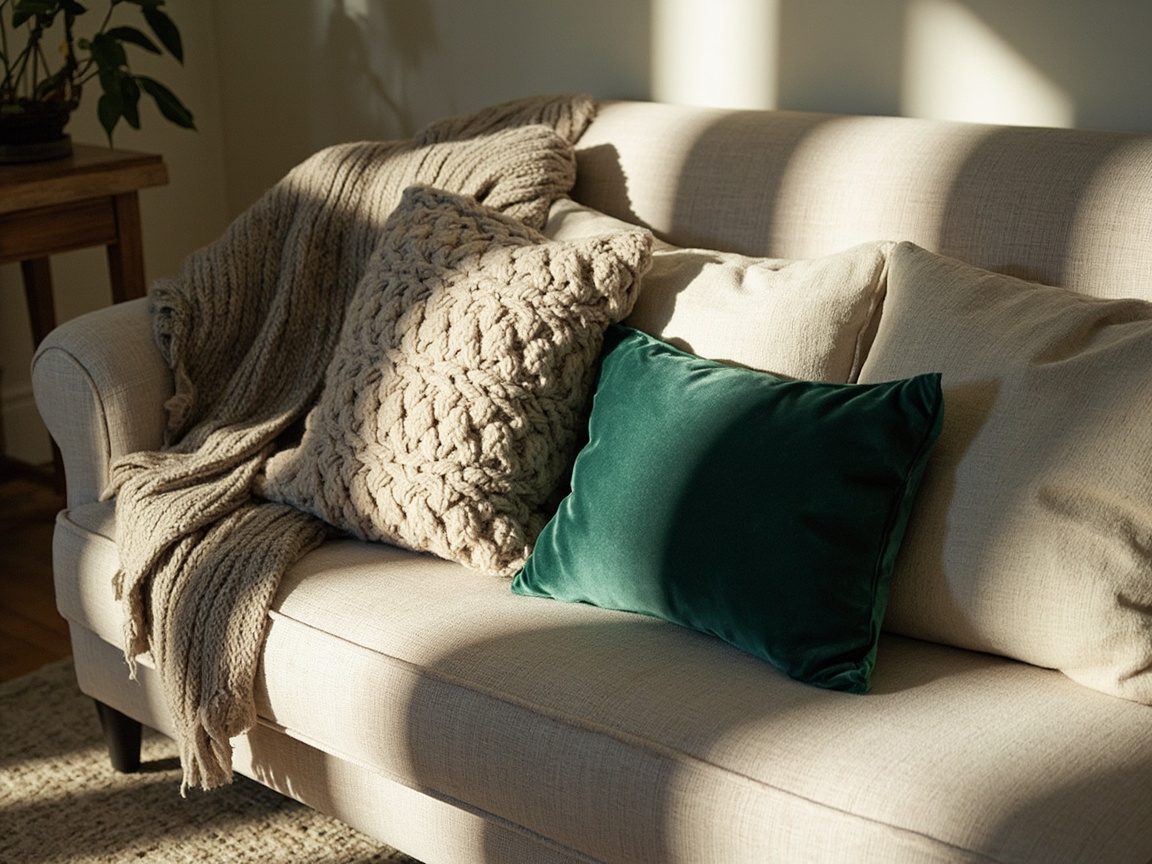
Shift the handfeel, not the entire palette
Seasonal refreshes are about texture weight. Keep your core color story steady, then rotate from open-weave linen and slub cotton in warm months to velvet, boucle, and chunky knits in cold months.
This keeps the room cohesive while matching the way light and touch change with the season.
Pair like weights sparingly, contrast the rest
If everything is plush, the eye gets sleepy. I like a 50,30,20 ratio, half smooth and crisp, a third plush or napped, and the final fifth with a statement texture like embroidery or fringe.
That mix photographs beautifully and feels layered without being busy.
| Season | Primary textures | Accents | Why it works | Care notes |
|---|---|---|---|---|
| Spring | Linen, cotton percale | Light embroidery, micro-piping | Breathable, catches morning light crisply | Steam instead of iron to keep slub character |
| Summer | Linen blend, cotton canvas | Woven stripes, rattan-look trims | Handles sunscreen and traffic, still airy | Washable down-alt inserts for easy upkeep |
| Fall | Velvet, chenille | Corded edges, small-scale plaid | Deeper pile absorbs warm light, adds mood | Brush nap with a clothes brush, spot clean |
| Winter | Boucle, wool knit | Faux shearling, tapestry | Heft and tactility make rooms feel intimate | Rotate weekly to prevent compression |
Blend texture with existing styles at home
Modern farmhouse interiors love the tension of crisp canvas against one or two velvets; see ideas similar to those in Modern Farmhouse Designs.
Meanwhile, older farmhouse architecture can handle nubbier weaves and ticking stripes without feeling contrived.
- Limit heavy textures to two adjacent pillows, then break with a smoother cover.
- Echo one texture elsewhere, for example, a boucle throw, to make it look intentional.
- Test by touch at arm’s length. If everything feels the same, you need a contrasting hand.
Budget swaps that still look designer
Invest in inserts, economize on covers
In my experience, clients splurge on designer covers, then stuff them with limp inserts. Reverse it.
A high-quality feather down or down-alternative insert instantly makes an inexpensive cover look luxe because volume, loft, and corner “karate chop” hold are what your eye reads as quality.
Prioritize 100 percent feather, 90/10 feather down, or a firm down-alternative for allergies. Size up your insert 2 inches over the cover for squared edges and a tailored silhouette, which is the designer’s tell.
| Insert Type | Best For | Feel/Loft | Allergy Friendly | Typical Cost (20×20) | Pro Note |
|---|---|---|---|---|---|
| 100% Feather | Casual sofas, layered beds | Soft, moldable | No | $$ | Great chop, may flatten with heavy use |
| 90/10 Feather/Down | Living rooms, show pillows | Plush, springy | No | $$$ | Luxury look with better loft retention |
| Down-Alternative (Microfiber) | Kids, rentals, allergies | Medium-firm, resilient | Yes | $$ | Holds structure, easy to launder |
| Polyfill | Outdoors, budget sets | Firm, less moldable | Yes | $ | Use only for accent or lumbar sizes |
Choose elevated fabrics without the price tag
You can mimic designer textiles with strategic fabric choices. Linen blends, cotton slub, and performance bouclé read expensive, while flat synthetics tend to look shiny.
I continually see clients overlook texture, yet this is what gives dimension on camera and in person.
Look for concealed zippers, piped edges, or flange details. These construction cues elevate even an under-$25 cover. Meanwhile, patterned fronts with solid backs can halve your cost if you rotate seasonally.
| Fabric | Look/Texture | Durability | Price Tier | Designer Swap For |
|---|---|---|---|---|
| Linen-Blend | Matte, nubby | High | $$ | Pure Belgian linen |
| Cotton Slub | Soft, irregular weave | Medium | $ | Handwoven cotton |
| Performance Bouclé | Loopy, plush | High | $$ | Designer wool bouclé |
| Faux Velvet (Matte) | Low sheen, saturated color | Medium | $ | Silk or cotton velvet |
Scale and quantity: where to save and where to show
Anchor pillows carry the visual weight, and accents add personality. Spend on two 22–24 inch anchors and a quality lumbar, then fill in with budget 18–20 inch accents.
The hierarchy convinces the eye that the whole arrangement is designed.
For sofas under 84 inches, I opt for 22-inch anchors, two 20-inch accents, and one 12×20 lumbar. For deep-sectionals, step up to 24-inch anchors and a 14×36 lumbar for proportion.
| Sofa/Bed Size | Anchor Size | Accent Size | Lumbar | Budget Strategy |
|---|---|---|---|---|
| Apartment Sofa, 70–84 in | 2 × 22 in | 2 × 20 in | 12×20 | SPLURGE on anchors + lumbar, SAVE on accents |
| Deep Sectional, 90+ in | 2–4 × 24 in | 2–4 × 22 in | 14×36 | SPLURGE on first pair only, SAVE on repeats |
| Queen Bed | 2 × 24 in | 2 × 20 in | 14×24 | SPLURGE on bed lumbar, SAVE on accents |
Color and pattern: curate like a pro, on a budget
Choose one hero pattern, one textured solid, and one small-scale print to tie the room’s palette. This three-note formula looks intentional, and curbs impulse buys.
I like to pull two colors from existing rugs or artwork, then add one unexpected contrast for energy.
If you want a seasonal refresh, swap only the textured solids. Keep the hero pattern and lumbar constant. For farmhouse or cottage rooms, integrate classic stripes and ticking, then layer with soft florals as shown in these Cottage Bedding Ideas.
Sourcing tactics the trade actually uses
I mix mid-market covers with fabric remnants and sample sale finds. Order swatches, then buy covers from two to three vendors to avoid a “set” look.
Finally, check the zipper length, at least 70 percent of the pillow’s edge, for easy insert loading.
- Size up inserts by 2 inches for square covers, 1 inch for lumbars.
- Choose concealed or YKK zippers; avoid flimsy plastic teeth.
- Use pairs only for anchors; let accents vary for a designer’s asymmetry.
Maintenance tricks to keep pillows crisp
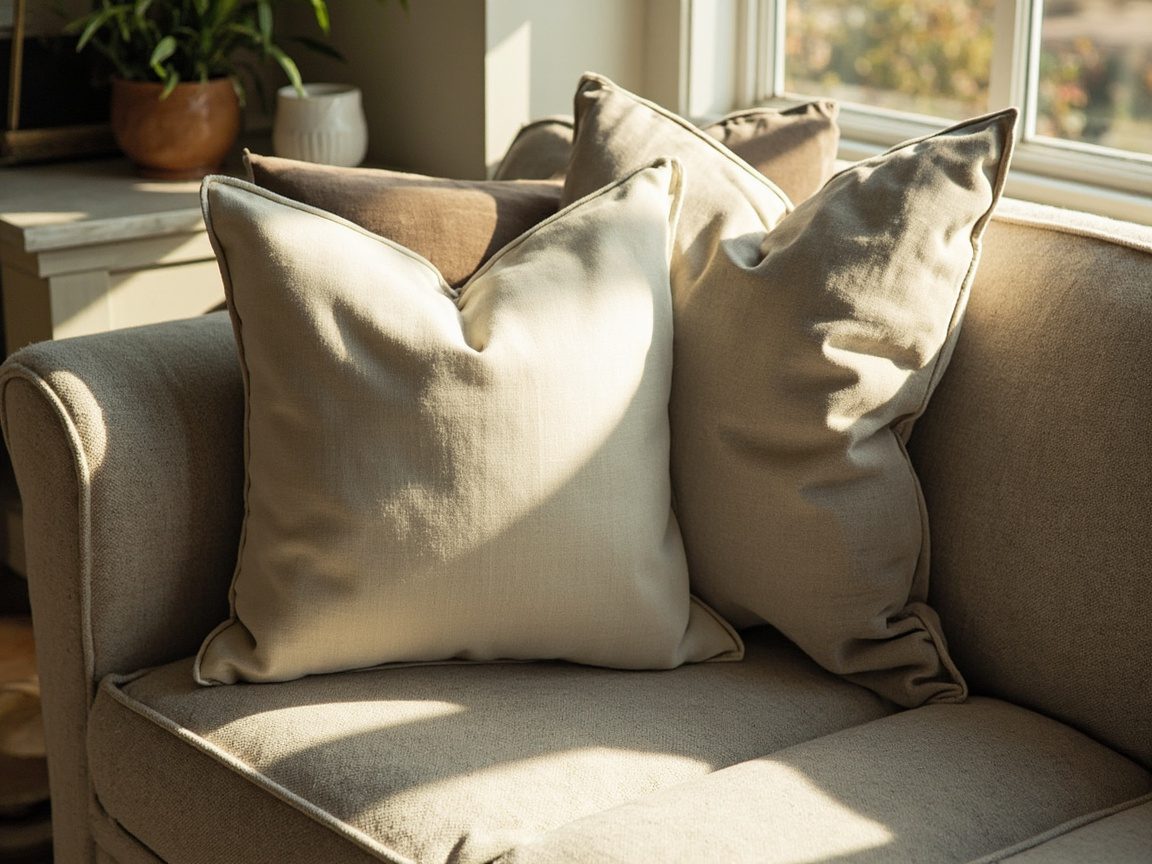
Daily shaping and weekly refresh, the professional way
A 10-second fluff keeps the structure longer than any deep clean. Hold the insert corners, snap downward to distribute fill, then do a soft chop for definition. Rotate inserts weekly, especially on your most used seat, so the loft compresses evenly.
Once a week, tumble pillows without heat for 10 minutes with two clean tennis balls. This reactivates down and microfiber, lifting crushed fibers without washing. Meanwhile, smooth fabric with your palms to realign the weave.
Cleaning schedules by fabric and fill
The mistake I see most is over-washing, which degrades seams and dulls texture. Treat spot stains fast, then reserve full laundering for quarterly or seasonal intervals, depending on fabric.
Always separate covers from inserts unless your insert is labeled machine washable.
| Avoid over-drying, which cakes fibers | Routine Care | Wash Frequency | Drying Method | Key Warning |
|---|---|---|---|---|
| Linen/Linen-Blend | Vacuum with brush, steam to relax creases | Every 3–4 months | Air dry flat, light steam | Avoid high heat to prevent shine and shrink |
| Cotton/Cotton Slub | Spot clean promptly, gentle machine wash | Every 2–3 months | Low tumble, remove damp | Wash inside out to protect texture |
| Velvet (Faux) | Lint roll, steam from back side | Seasonally | Air dry only | Never iron pile, it will crush |
| Bouclé/Performance | Vacuum gently, blot spills | Seasonally | Air dry | Use mild upholstery cleaner, no scrubbing |
| Down/Feather Inserts | Air out, sun for 1 hour | Every 6–12 months | No-heat tumble with balls | Ensure fully dry to prevent odor |
| Down-Alt/Poly Inserts | Shake and rotate | Every 3–6 months | Low heat tumble | Avoid over-drying which cakes fibers |
Stain strategy that preserves texture
Blot, never rub. Work from the edge toward the center to prevent rings. Use a mild detergent mix, one teaspoon in one cup of cool water, then finish with a clean water blot to remove residue that attracts soil.
For oil-based stains on velvet or bouclé, apply cornstarch for 15 minutes before vacuuming. Protein stains respond to cool water, not hot, which sets them. Test any cleaner on a hidden seam first.
Storage, rotation, and sun management
Ultraviolet exposure fades dark textiles first. If your sofa sits in strong light, rotate pillow positions monthly and consider UV film on windows to protect textiles, the same approach I use in photo-styled rooms. For off-season covers, store flat in breathable cotton bags with silica packs.
Keep inserts in labeled bins by size, 20, 22, 24, so swapping is quick.
FAQ
Four to five works best: two 22-inch anchors, two 20-inch accents, and an optional lumbar. Keep at least 18 inches of open seat depth.
Yes, size increases by 2 inches for squares and 1 inch for lumbars. This fills corners and keeps edges crisp.
Combine one large-scale motif, one small-scale print, and one textured solid. Keep a shared color thread across all three.
They hold shape better and are allergy-friendly, though they lack the same drape. For high-traffic seating, I often prefer firm down-alt.
Final Thoughts
Designer-looking pillows come from proportion, insert quality, and smart fabric choices, not price tags. Build a core set, maintain it with quick weekly care, and rotate seasonally for a room that always reads finished.