


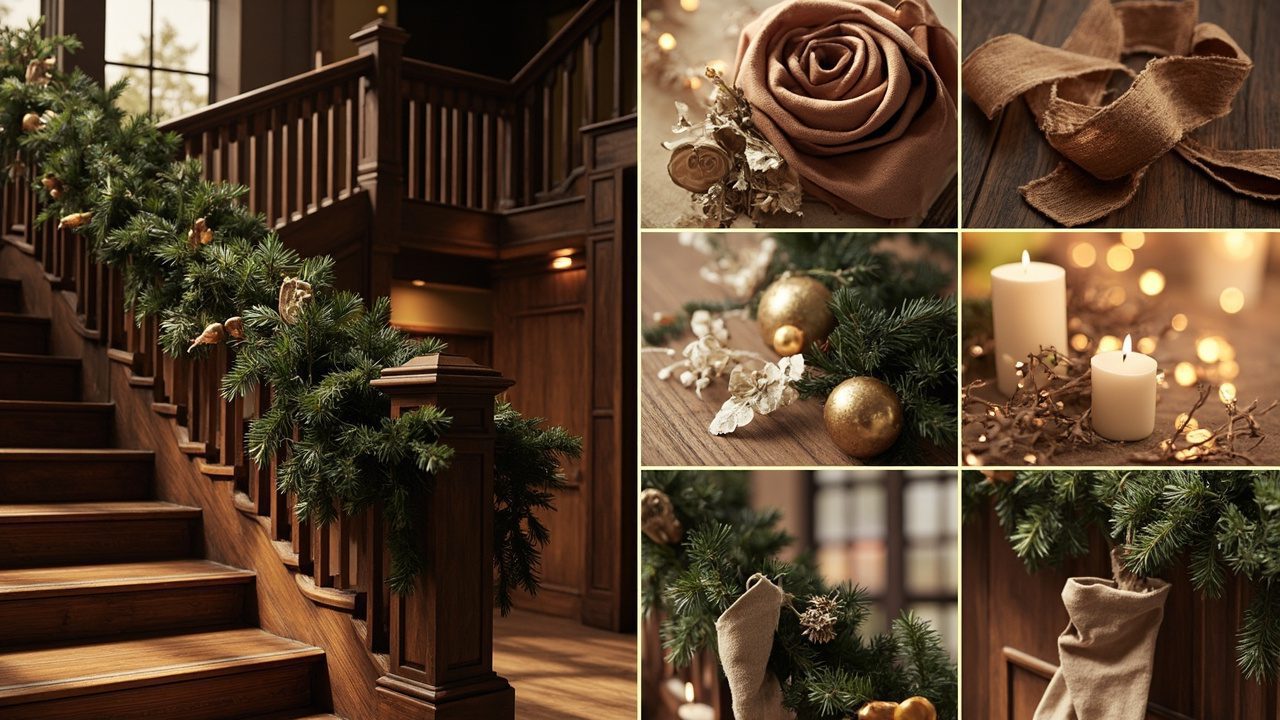
This holiday season, the staircase should do more than connect floors—it should set the tone for the whole house the moment guests step inside.
Think of the stair run as a vertical mantel: it needs weight, rhythm, and a clear eye line from the front door.
Prioritize materials and placement so that decorations appear intentional rather than tacked on; scale down bulky items on narrow treads and keep heavy adornments away from traffic paths to prevent accidents.
Focus on texture and layered lighting to make the ascent memorable after dark. Combine warm bulbs, low-slung garlands, and tactile elements, such as wool, woven ribbons, and natural greenery, to create a route that feels both festive and lived-in.
Below are 11 practical, field-tested concepts that consider structure, safety, and stylistic flexibility so your staircase looks curated and performs all season.
- 1. Lightweight Floating Balusters
- 2. Warm Wood Tones
- 3. Personalized Runner Patterns
- 4. Integrated LED Strips
- 5. Minimalist Glass Rails
- 6. Layered Greenery Garlands
- 7. Textured Wool Runners
- 8. Mixed-Metal Accents
- 9. Hidden Storage Drawers
- 10. Ornamental Newel Caps
- 11. Seasonal Accent Vignettes
- FAQ
- Final Thoughts
1. Lightweight Floating Balusters
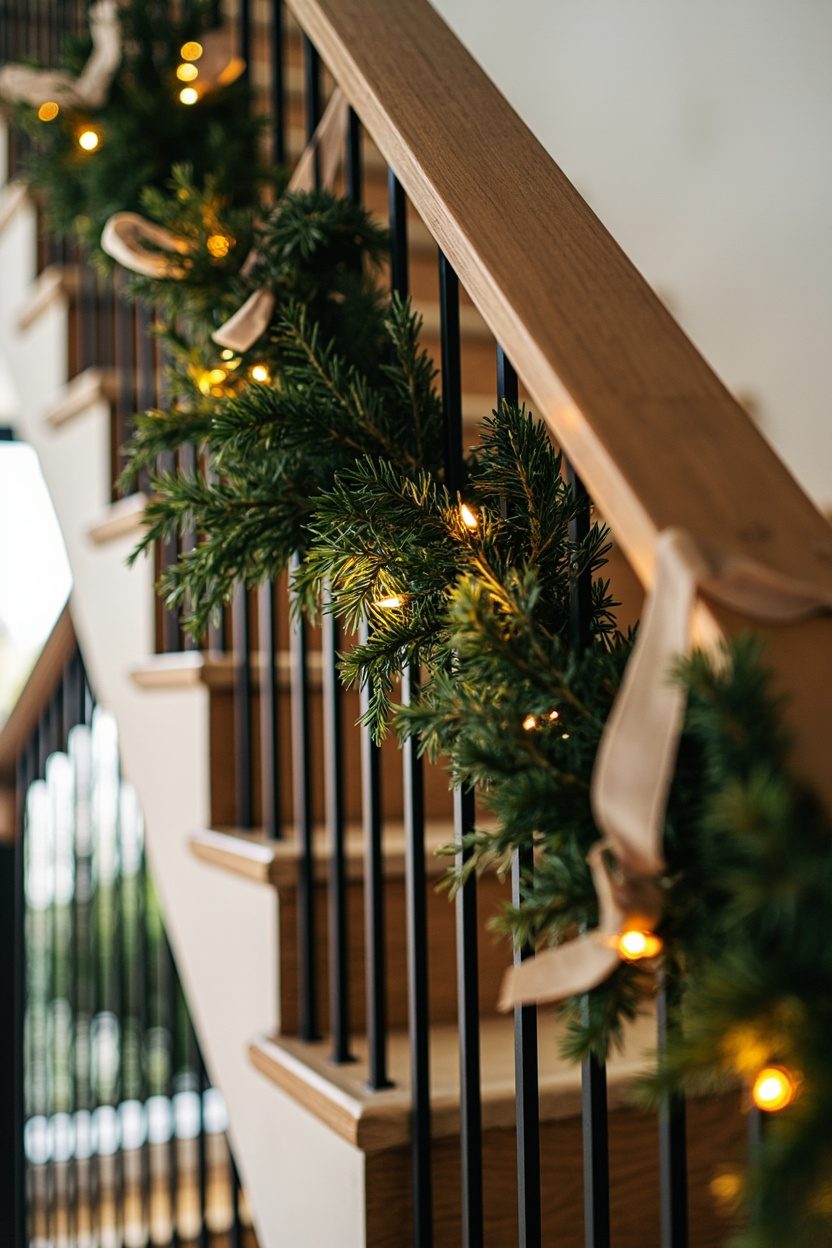
Floating balusters, thin metal or acrylic rods that tuck under the handrail, visually lighten a staircase and create a crisp backdrop for holiday accents. Use them when you want garlands or simple wreaths to be the star.
The open sightlines let decorations read from both upstairs and the entryway without blocking light or making the stairs feel heavy.
Choose slim blackened steel for contrast in a bright entry, or clear acrylic for a near-invisible modern look; avoid anything wider than 1/2″ if your goal is that airy effect.
For installation, clip the garland to the handrail rather than to each baluster to reduce holes and prevent stress on slim elements. Use clear adhesive-backed cable ties or small brass clips spaced 18–24″ apart.
If children or pets are in the home, add a subtle low-profile mesh behind the balusters to stop small hands while keeping the floating aesthetic intact.
Mistakes to avoid: hanging oversized ornaments on the balusters themselves—they will swing into the stair path and read cluttered.
Styling Blueprint
- Choose metal or acrylic balusters under 1/2″ for a light visual field.
- Anchor garlands to the handrail with clear cable ties every 18–24″.
- Use a sheer safety mesh for homes with kids or pets.
- Skip heavy ornaments directly on balusters to avoid swing hazards.
2. Warm Wood Tones
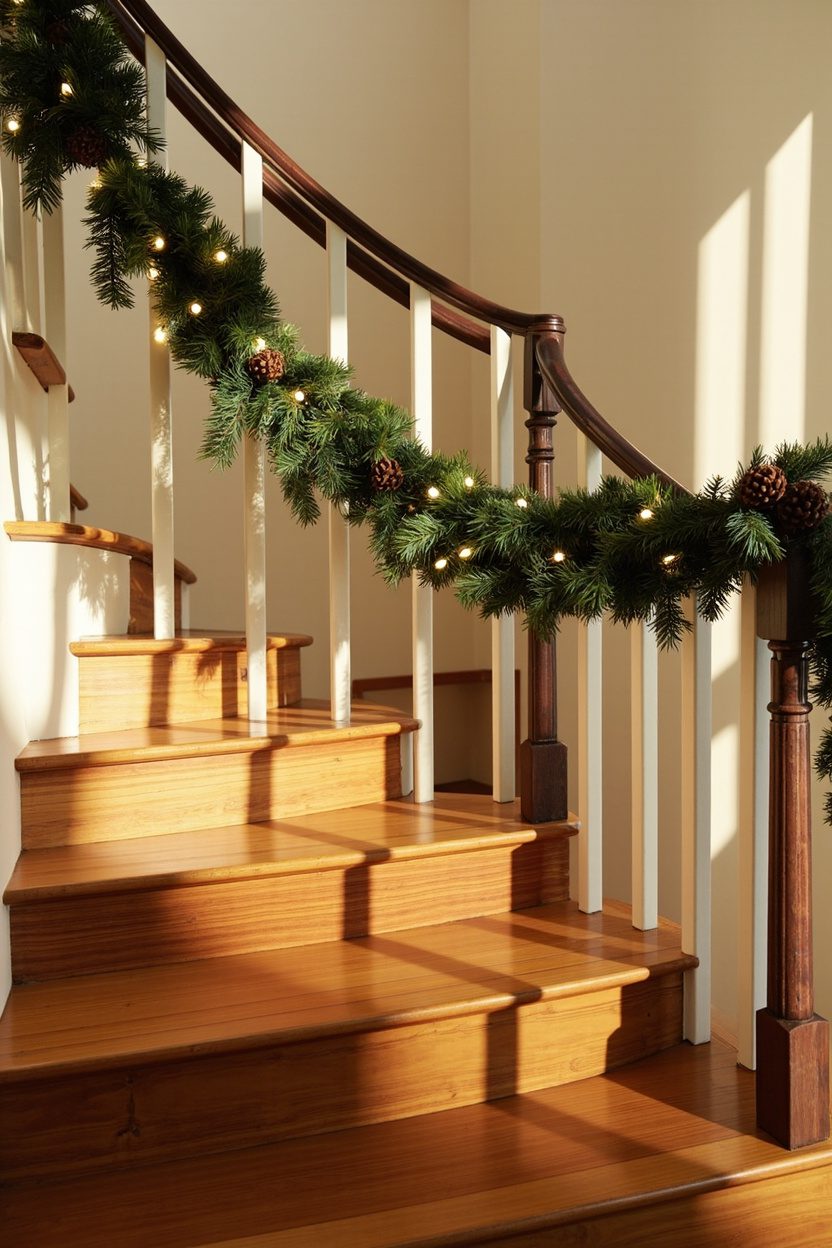
Introducing warm wood tones—stained treads, a walnut handrail, or reclaimed-wood trim instantly creates a cozy holiday atmosphere that plays well with faux fur, plaid, and cider-scented candles.
Go for medium-to-dark stains (walnut or chestnut) on the risers and treads to anchor the space; pair them with warm LED uplighting on the stringer to emphasize grain and add depth at night.
If your budget is tight, add a wood-tone runner or stair treads rather than refinishing the entire staircase.
When styling, offset the wood with metallic accents: brushed brass candle sconces on the stair wall or copper ribbon woven through garlands. Be mindful of contrast—if your walls are already deep, choose lighter wood tones like honey oak.
Avoid a mismatch of finishes; pick one dominant wood tone and incorporate smaller accents in the same temperature to keep the look cohesive.
Essential Elements
- Select a dominant wood tone (walnut, chestnut, or honey oak) for visual cohesion.
- Add warm LED uplights along stringers to highlight grain after dark.
- Use a wood-tone runner if full refinishing isn’t in the budget.
- Coordinate metal accents (brass or copper) to maintain warmth.
3. Personalized Runner Patterns
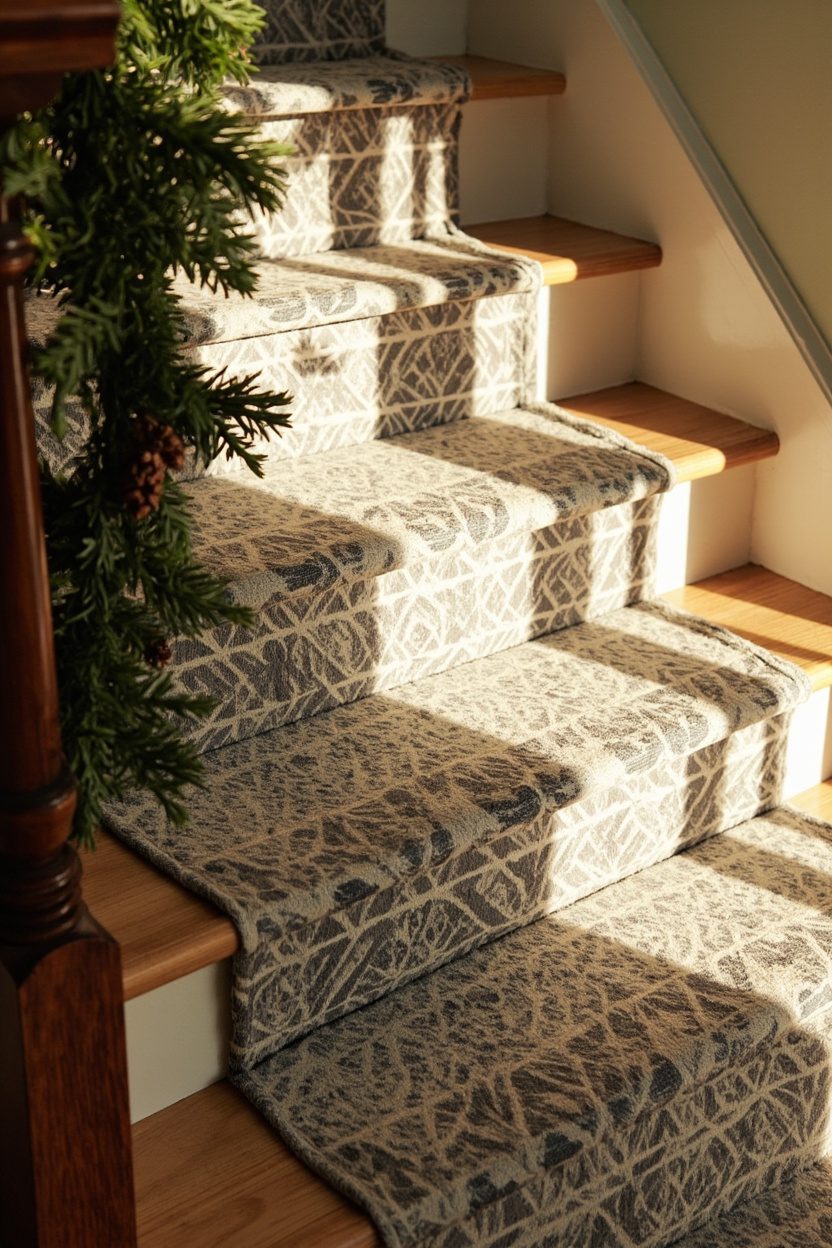
A patterned stair runner gives the staircase rhythm and becomes a canvas for holiday layering—think tartan stripes for a classic look or oversized geometrics for a modern twist.
Scale matters: choose a pattern repeat that aligns with tread width so motifs land centered on each step; a too-small repeat reads busy and cheap, while an oversized motif can feel clumsy on narrow stairs.
Wool-blend runners offer the best balance of durability and dye richness for patterns that will stand up to heavy traffic and seasonal decorating.
For personalization, stencil initials, a monogram border, or a thin metallic pinstripe down the runner’s edge to make the staircase feel custom without a big budget.
Secure runners with stair rods or hidden non-slip tape; avoid loose rugs that can bunch underfoot. If you’re layering garlands, keep the runner’s color palette in the same temperature family to prevent visual competition.
What to Focus On?
- Match pattern repeat to tread width to keep motifs centered on each step.
- Choose wool-blend for durability and color saturation in patterned runners.
- Personalize with monogram stencils or a metallic pinstripe along the edge.
- Anchor with rods or non-slip tape; never leave the runner loose.
4. Integrated LED Strips
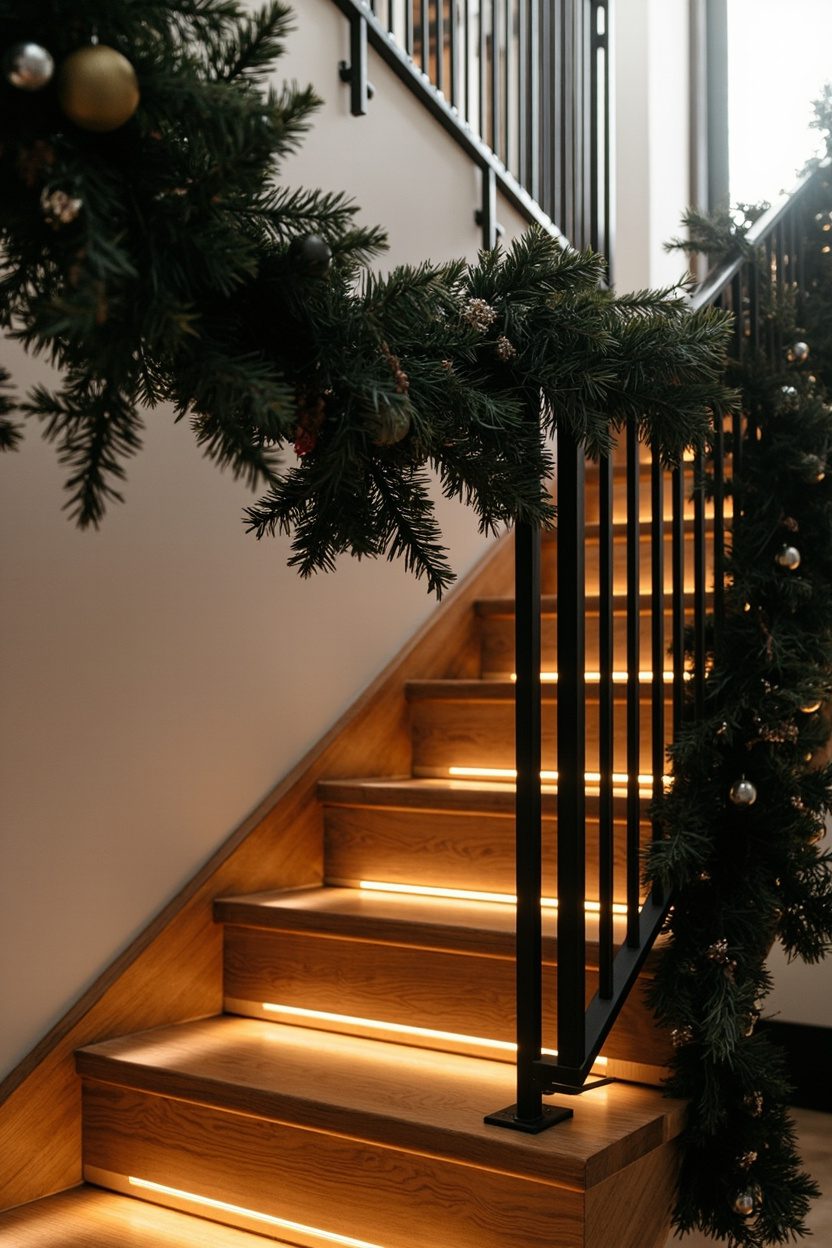
LED strips recessed into the stair treads or under the nosing make a modern, safe holiday statement without competing with wreaths or garlands. Choose warm 2700K–3000K LEDs for a cozy glow; harsh cool whites will read clinical against traditional ribbons and pine.
Install the strips with diffusers to avoid visible hot spots and plan the wiring run to a nearby outlet or transformer—budget $150–600 for quality LED tape and driver, more if you hire an electrician for recessed channels.
This approach keeps decorations minimal while elevating layered displays like a garland along the banister or clustered ornaments on alternating steps. Avoid over-lighting: keep the strips on a separate dimmer or smart switch so the LEDs can be low-level ambient light while decorative elements get the visual focus.
For open risers, run the strip on the underside of each tread to highlight the stair profile without creating glare for people on the stairs.
What to Focus On?
- Specify warm color temperature (2700K–3000K) for holiday warmth and skin-tone flattering light.
- Use frosted diffusers and recessed channels to hide individual diodes and prevent glare.
- Plan power access and place the driver near an outlet or in a nearby closet for code compliance.
- Include a dimmer or smart control so LEDs complement—not overpower—decorations.
5. Minimalist Glass Rails
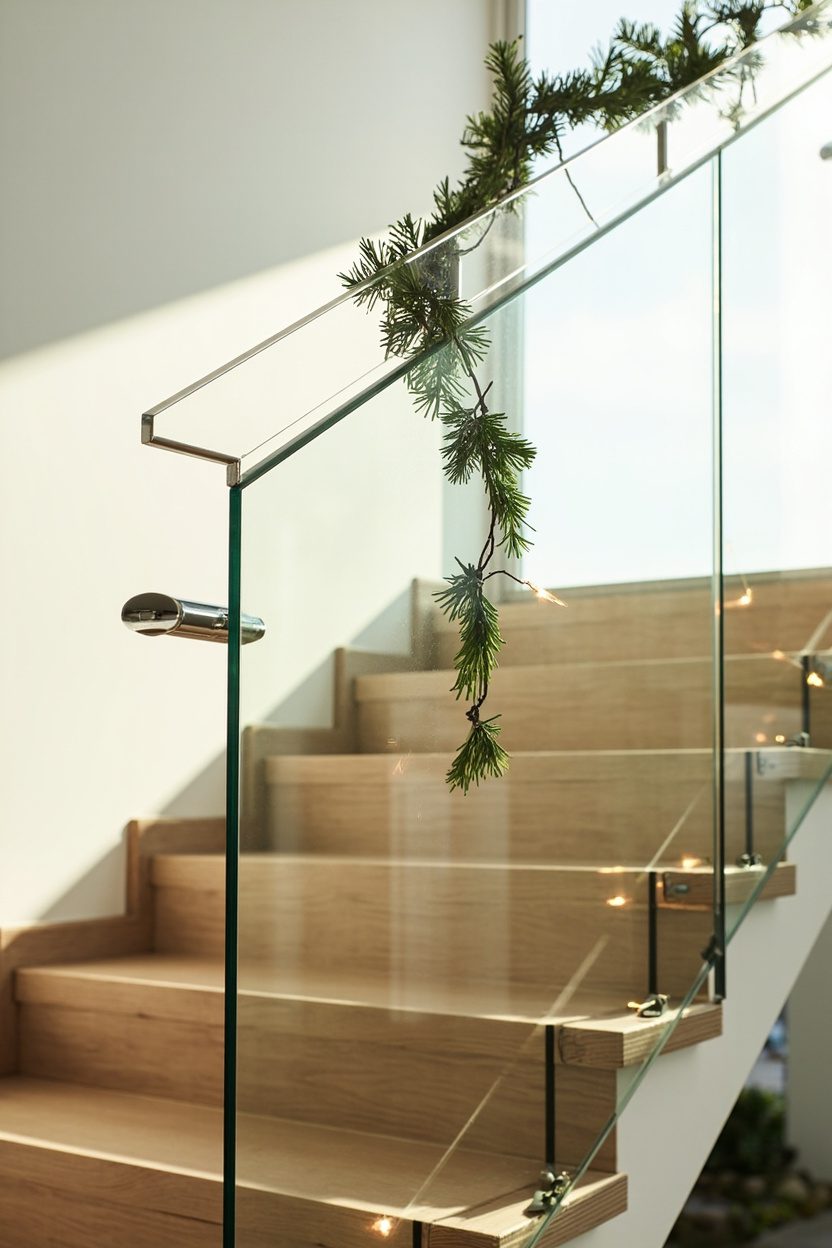
Glass balustrades stripped back to frameless panels create a faint, airy backdrop that lets holiday accents pop without visual clutter.
Opt for 10–12mm tempered glass with polished edges and stainless-steel clips for a clean, durable installation; this thickness balances transparency and stiffness on runs up to about 1.2–1.5 meters between posts.
Keep the handrail slim, matte black or natural oak at 30–45mm diameter to anchor the glass without adding bulk.
When decorating, rely on suspended ornaments, narrow garlands, or suction-cup hooks so attachments don’t damage the glass or obscure sightlines. Avoid adhesive tapes that leave residue; instead, use clear fishing line for hanging baubles and removable glass-safe hooks for greenery.
For homes with kids or pets, add a thin, clear-edge protector at the base to prevent chips from vacuuming and heavy foot traffic.
Essential Elements
- Choose 10–12mm tempered glass panels for strength and minimal visual distortion.
- Select a slim handrail in black or warm wood to create contrast without bulk.
- Hang decorations with fishing line or removable glass-safe hooks to protect surfaces.
- Add a clear base protector along the skirting to prevent chip damage from cleaning or vacuums.
6. Layered Greenery Garlands
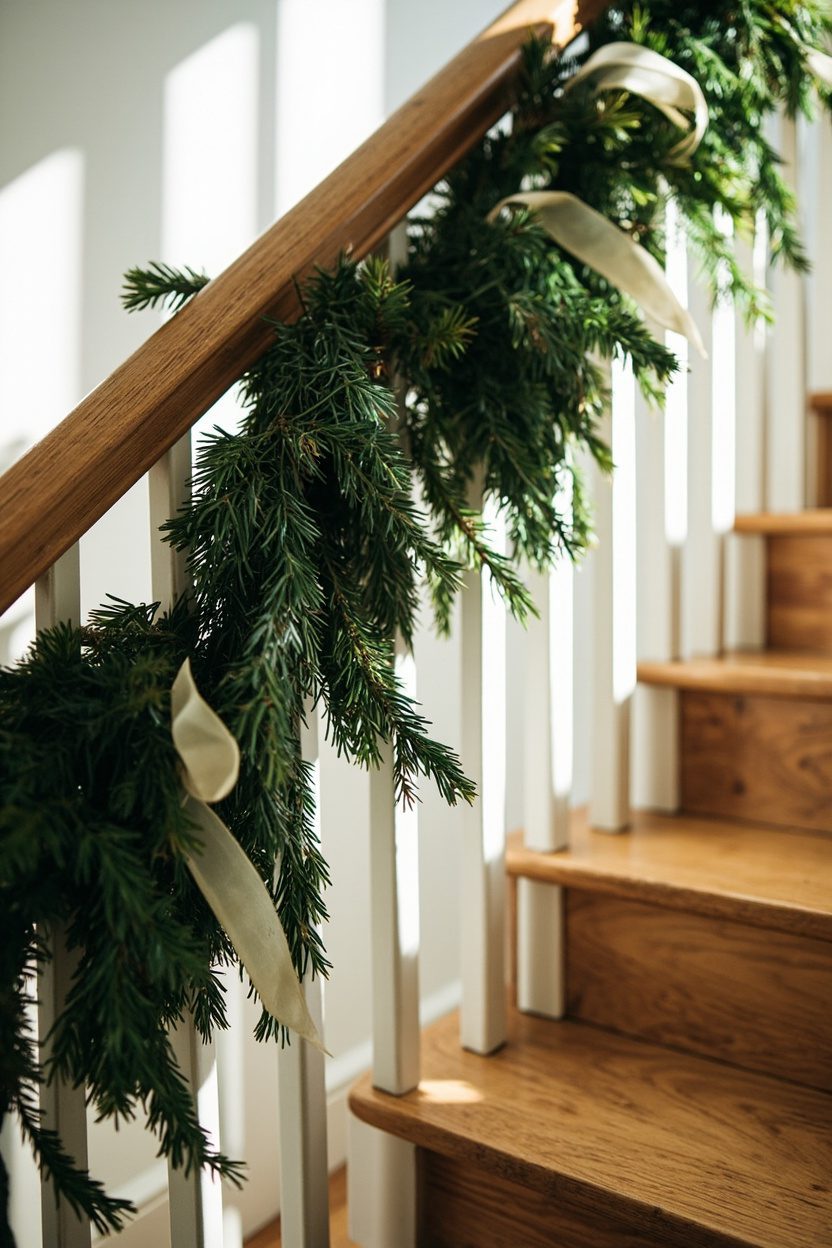
Layering garlands, mixing faux magnolia leaves with real pine and seeded eucalyptus, gives depth, scent, and longevity to staircase décor.
Use a living base of eucalyptus for scent and texture, tuck faux magnolia or boxwood for structure and reuse, and add pine sprigs sparingly so the needles don’t shed all over treads.
Secure each section with clear floral wire and anchor points every 18–24 inches; a continuous 12–15-foot run typically needs 8–12 anchor points, depending on heaviness.
Avoid heavy, overstuffed garlands that sag or block sightlines on narrow stairs; instead, work in 2–3 inch diameters layered for fullness.
Integrate small clusters of ornaments or LED fairy lights woven through the layers, but keep battery packs hidden behind newel posts or inside the garland near the top landing.
If you use fresh greenery, plan for disposal and replacement mid-holiday to avoid brittle, brown sections.
Styling Blueprint
- Base with eucalyptus for scent, add faux magnolia for structure, and insert pine for seasonal texture.
- Anchor garlands every 18–24 inches with clear floral wire to prevent sagging.
- Weave battery fairy lights with concealed packs near newel posts to avoid visible wiring.
- Limit garland depth to 2–3 inches on narrow stairs to preserve sightlines and safety.
7. Textured Wool Runners
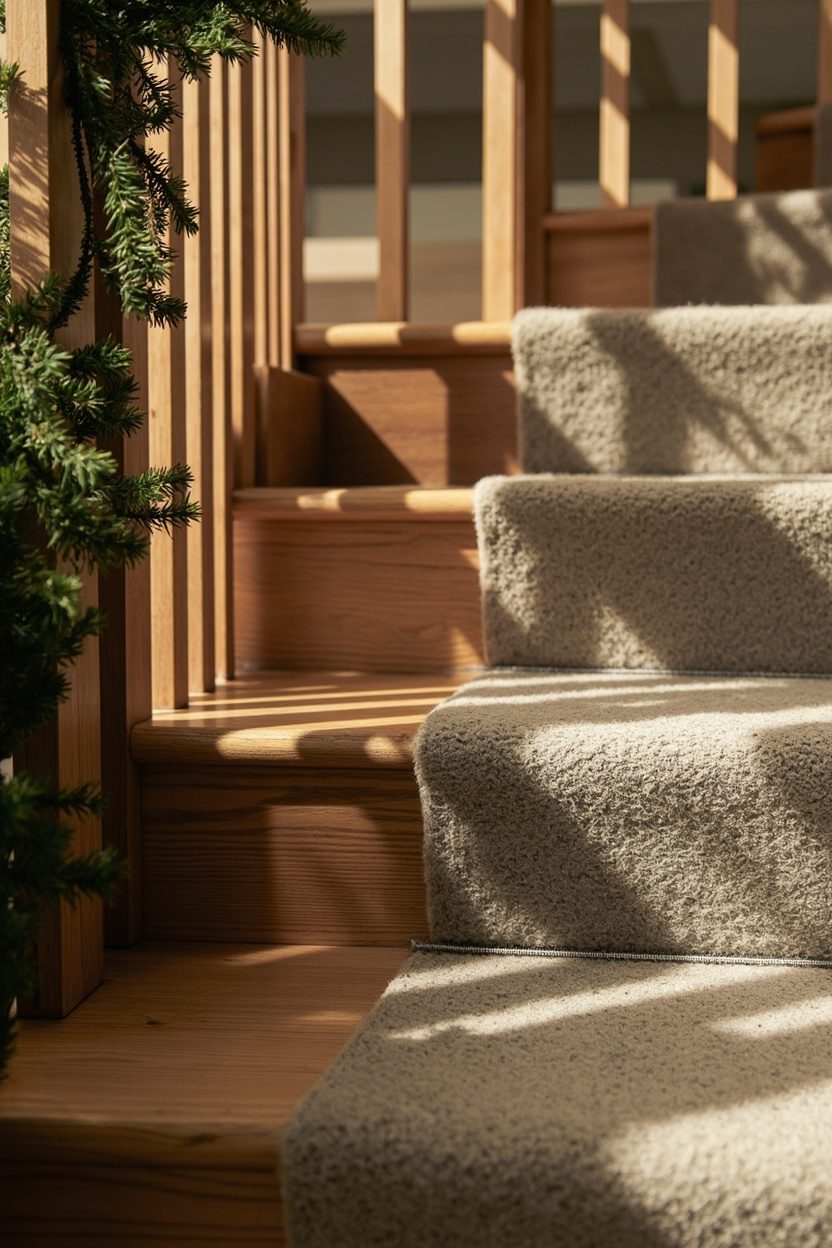
A thick, hand-tufted wool runner immediately changes how a staircase reads from cold transit to tactile centerpiece.
Opt for a 3/4-inch pile in a warm neutrals palette (ecru, oat, or graphite fleck) to add depth without hiding the wood grain; choose 24–30 inches in width on standard treads so the side rail and nosing still show for balance.
Prioritize natural latex backing for grip and a thin jute layer underneath if you need extra traction but want to avoid full stair carpeting costs (budget tier: mid-range, $40–$120/linear foot depending on loom and fiber quality).
Layering texture is the point: pair the wool with matte brass stair rods (use only at top and bottom to avoid a Victorian pastiche) or contrast with a slim black metal railing to modernize the look.
Avoid overly busy patterns on narrow stairs they make steps indistinct and are a safety hazard; choose subtle herringbone, tonal stripes, or a heathered field instead.
Styling Blueprint
- Select pile height 1/2″–3/4″ for durability and comfort on high-traffic stairs.
- Keep runner width 24″–30″ on standard 36″ staircases to show wood edges.
- Mount with discrete carpet tape and stair rods only where alignment needs reinforcement.
- Choose wool with a stain-resistant finish if pets and kids use the stairs regularly.
8. Mixed-Metal Accents
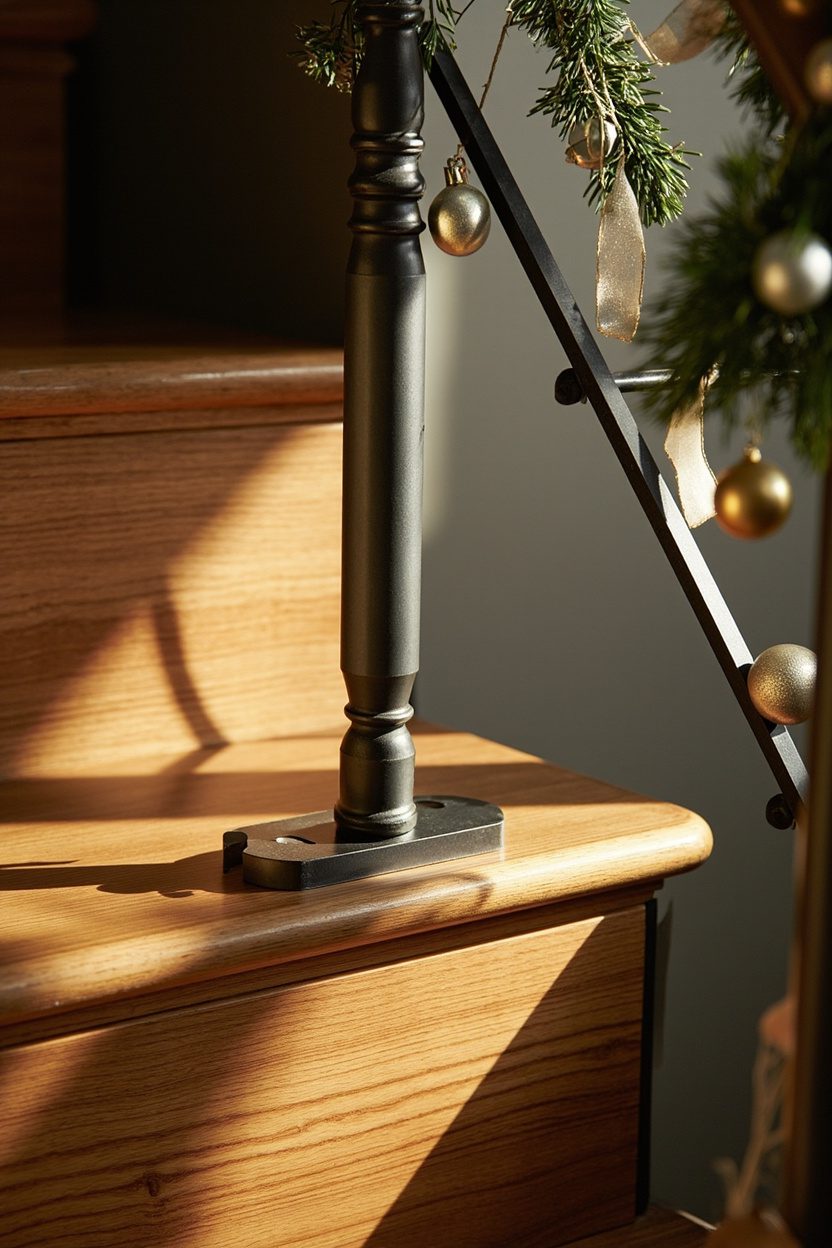
Introducing mixed metals on a staircase (think matte black balusters, satin brass handrail, and antique bronze newel caps) reads intentional and layered rather than mismatched when you limit the palette to two dominant tones plus one accent.
Keep the largest surface of the handrail or newel post in the warmer metal to make the fixture feel inviting; reserve the cooler metal for secondary elements like spindles or brackets.
For a cohesive edit, repeat the accent metal elsewhere in the entry (light fixture or console hardware) within 10–15 feet to create visual dialogue.
Be mindful of scale: chunky brass handrails overpower delicate iron spindles, so match heft to form — slender stainless spindles pair with slim, linear rails; heavy Victorian newels need equally substantial caps.
If budget is a concern, use plated or powder-coated finishes on less-touched pieces and reserve solid brass for hand-contact surfaces where wear will show less and patina adds charm.
What to Focus On?
- Choose two primary metals and one accent to avoid a cluttered look.
- Match metal scale to architectural style; heavy metals for traditional, slim for contemporary.
- Repeat metals in nearby fixtures within visual range for cohesion.
- Use durable finishes on handrails to withstand oils and abrasion.
9. Hidden Storage Drawers
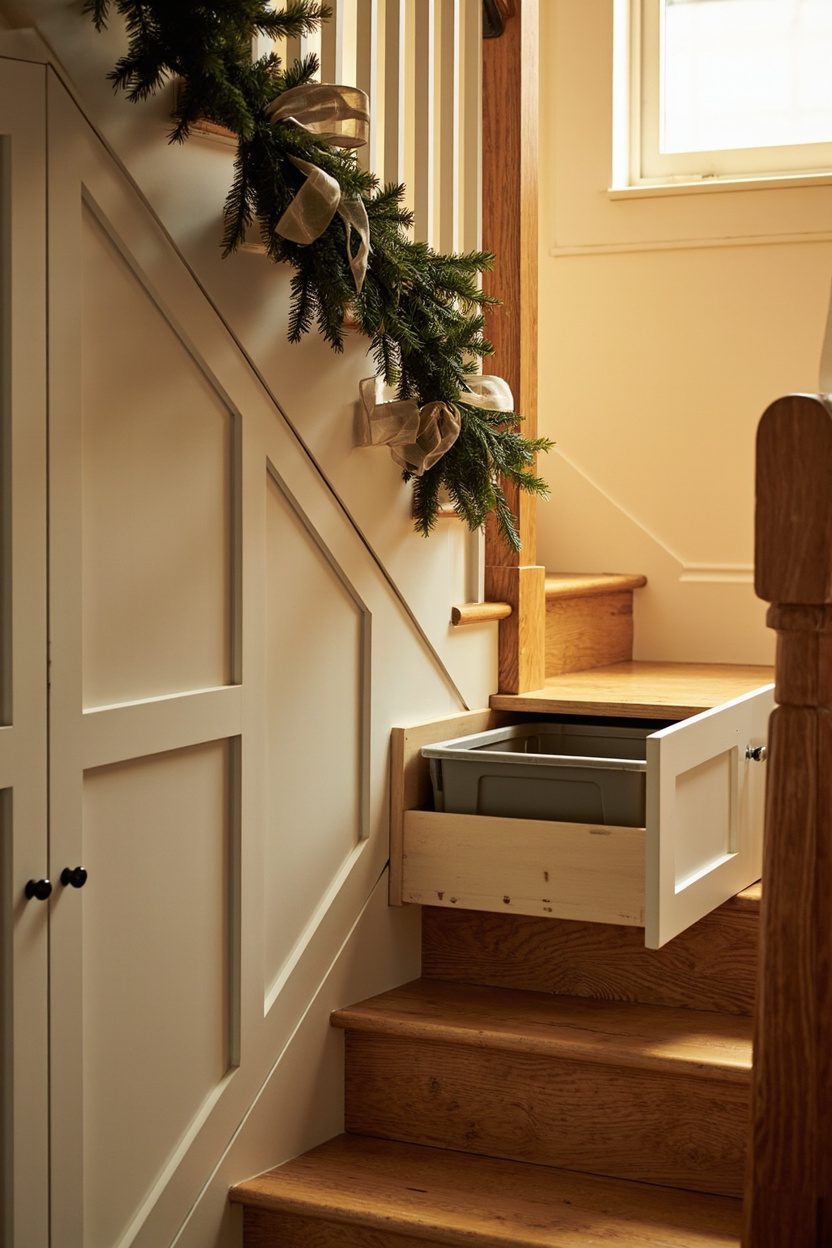
Pull-out drawers built into the risers or under the bottom stair solve real entryway problems while keeping decor tidy during holiday gatherings.
For functional access, design drawers at least 6–8 inches deep with soft-close slides and full-extension hardware; use plywood with oak or maple veneer for a durable, paintable face that can be stained to match treads.
If retrofitting, prioritize the lowest two-to-three steps for storage — they’re easier to widen without structural work and are perfect for wrapping paper, seasonal table linens, or shoe storage.
A practical mistake to avoid: shallow, fiddly cubbies behind risers that can’t hold anything useful. Instead, create full-width drawers on alternating steps or a single large drawer beneath the landing for bulky items (holiday wreaths, tree ornaments).
Keep visible fronts minimal, a flush panel with concealed finger-groove pulls reads as millwork rather than DIY storage and pairs well with both farmhouse and modern entries; see related cabinetry approaches in open millwork guides on Home Design.
Essential Elements
- Use full-extension soft-close slides for smooth operation and longevity.
- Build fronts from 3/4″ hardwood veneer for paint or stain, matching the stair finish.
- Reserve the lower steps or landing for storage to minimize structural alteration.
- Design fronts flush with nosing and use concealed pulls for a clean look.
10. Ornamental Newel Caps
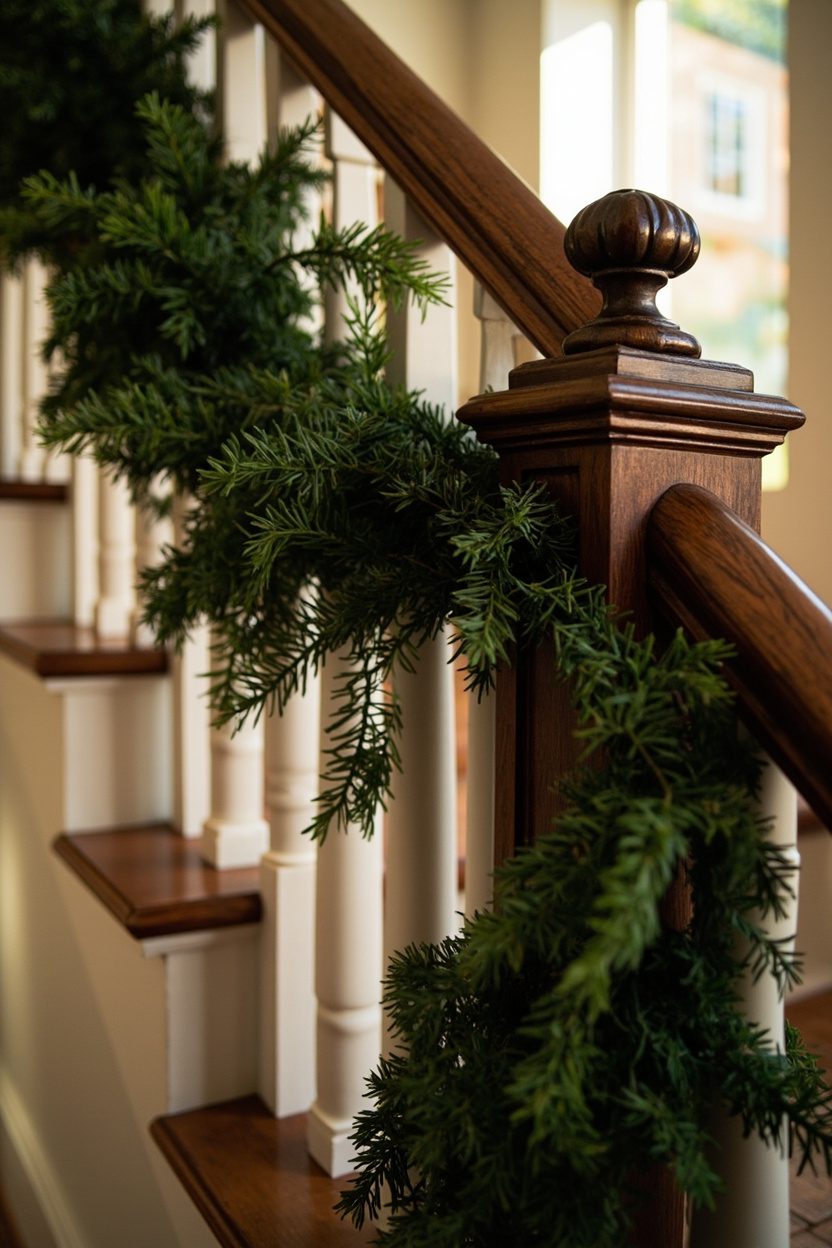
Ornamental newel caps swap a bland staircase post for a focal point that anchors holiday decor. Choose caps in warm metals like aged brass or oil-rubbed bronze to complement garlands; for painted banisters, pick a matte black or deep walnut cap to read as a deliberate contrast rather than an afterthought.
A practical detail: measure the post head (most are 3.5–4.5 inches square) so the cap fits snugly avoid garden-variety caps that wobble or require hefty carpentry to secure.
These caps also offer a tether point for seasonal elements—mini wreaths, ribbon tails, or a string of tiny ornaments without damaging the wood. If your budget is tight, swap a single statement cap at the bottom of the run rather than replacing every post; that one upgraded anchor (cost tier: $40–$200 depending on material) delivers the visual punch of a full overhaul. Avoid overly ornate, heavy caps on thin posts to prevent structural strain or a top-heavy look.
What to Focus On?
- Match cap scale to post size (3.5–4.5 in. common).
- Prefer warm metals or matte finishes for holiday warmth.
- Use one statement cap at entry for impact on a budget.
- Secure caps with screws or an adhesive plate to prevent wobble.
11. Seasonal Accent Vignettes
Seasonal accent vignettes positioned on landings or the stair base create invitation points that read like set design. Combine a bench or small console, layered textiles (wool throw or faux fur), and a sculptural lantern with battery candles to create an approachable scene; pick textiles in one dominant color plus a metallic accent for cohesion.
Keep scale in mind: on narrow landings, choose low-profile seating (12–16 inches high) so sightlines up the stairs remain open.
Rotate vignette components by holiday: pine bundles and red-berry stems for winter, amber glass and dried grasses for autumn.
A smart decision is to anchor the vignette with a single durable piece (like a metal lantern or wooden crate) you’ll reuse each year, spend here once, and swap inexpensive seasonal add-ons (budget tier: $20–$60 per season). Avoid cluttering the walking path; leave at least 32 inches of clearance for safety and flow.
Styling Blueprint
- Anchor with one reusable piece (lantern/bench/crate).
- Layer textiles: base throw, accent pillow, small rug.
- Limit footprint to maintain 32 inches of clear passage.
- Swap accents seasonally to refresh without replacing anchors.
If you want another practical angle, read 10 Spring Floral Arrangement Ideas Beyond Easter.
FAQ
Use lightweight materials where possible and attach with removable hardware like Command hooks or ribbon tied to the post rather than nails. For heavier items, anchor to the newel post with screws and pre-drill pilot holes to avoid splitting wood. Consider a metal bracket hidden behind garland for load-bearing displays. Always test stability before leaving decorations unattended overnight.
Yes, pick one unifying element, such as a consistent metal finish or color palette, to tie them together.
Pair modern materials (clear acrylic, neon lights) with classic pieces (pine garland, brass newel caps) in odd-number groupings for balance. Limit competing patterns; use solids plus one textured accent like faux fur or woven ribbon. Reference home-wide cues from your home design to keep the staircase cohesive with adjacent rooms.
Use faux garlands and potted faux evergreens that require no watering and resist shedding.
Choose battery-operated LED candles and lights with timers for safe, hands-off illumination.
Opt for washable textile accents (indoor/outdoor rugs, removable slipcovers) for easy cleaning.
Keep fragile ornaments out of reach and secure décor to posts with Velcro straps or ties.
Add warm LED string lights along the handrail or within garlands to increase light without installation.
Place mirrored or metallic accents like brass caps or lanterns to reflect existing light.
Use battery-operated puck lights under steps or on landings for subtle uplighting.
Swap dark rugs for lighter-toned runners with higher contrast to the treads for perceived brightness.
Final Thoughts
Holiday staircase decor succeeds when thoughtful editing meets practical details, scale, secure attachment, and a clear anchor piece per scheme. Small investments like an ornamental newel cap or a reusable lantern pay dividends year after year, and seasonal vignettes give you the flexibility to refresh without a full redesign.
For inspiration that bridges style directions, consider how entry elements connect to broader trends in spaces such as the open concept floor plans of your home.