


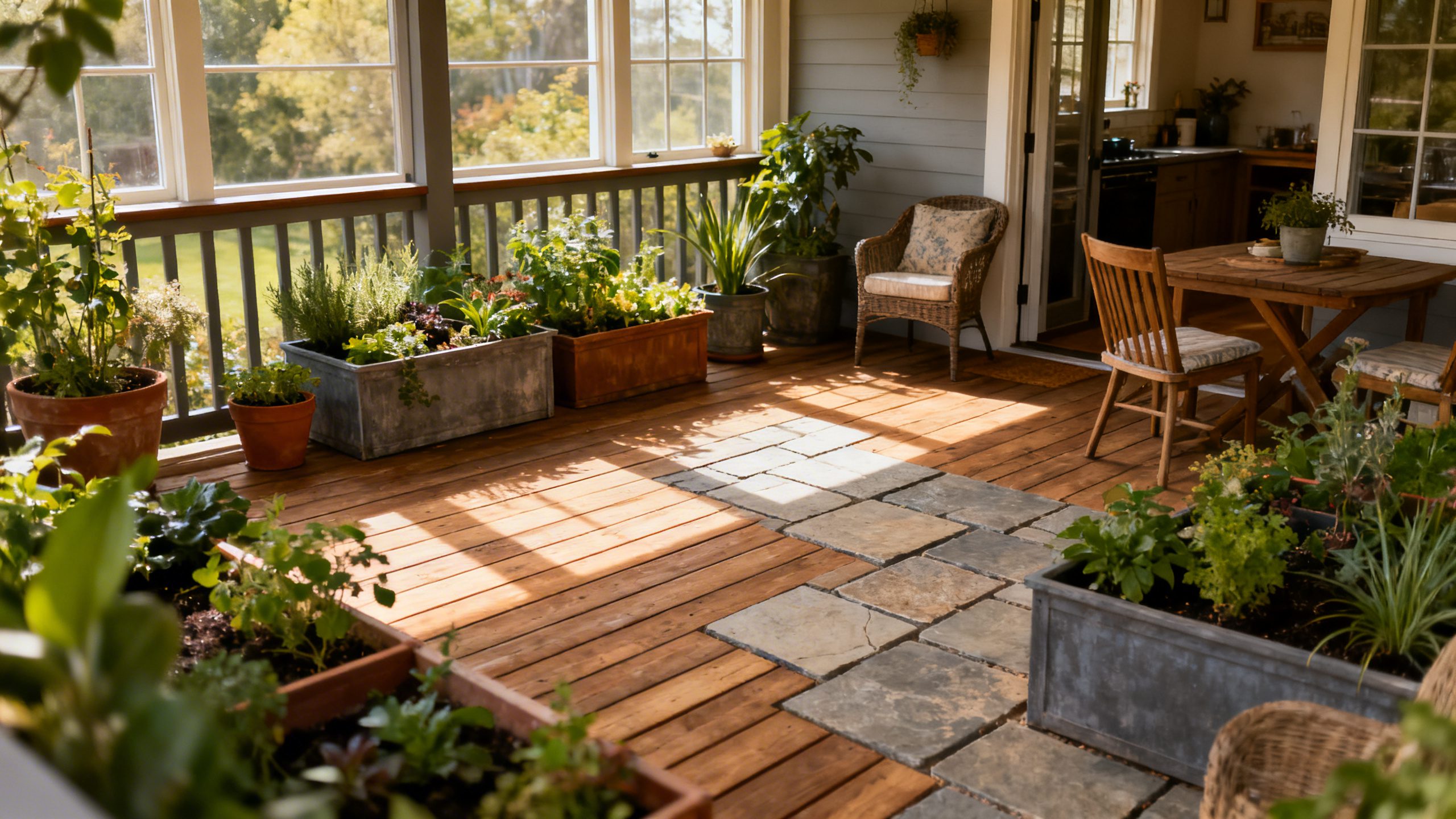
Gardening belongs where you live, not just where you mow. Adding Container Gardens to a Ground Level Deck is the fastest way to turn bare boards into a layered, green room that changes with the seasons.
In my projects, I treat the deck like a flexible floor plan, curating planters as “furniture” that define conversation zones, soften railings, and pull the eye to views.
The trick is choosing containers and plant mixes that respect weight limits, sun, wind, and maintenance.
- Choosing Containers That Suit Ground-Level Decks
- Weight, Drainage, and Protecting Deck Surfaces
- Designing Wind- and Sun-Smart Plant Combos
- Low-Maintenance Plant Palettes for Busy Weeks
- Irrigation Options for Containers on Decking
- Layout Strategies for Traffic Flow and Views
- Cold, Heat, and Overwintering on the Deck
- Budget Breakdown: Pots, Soil, and Upkeep
- FAQ
- Final Thoughts
Choosing Containers That Suit Ground-Level Decks
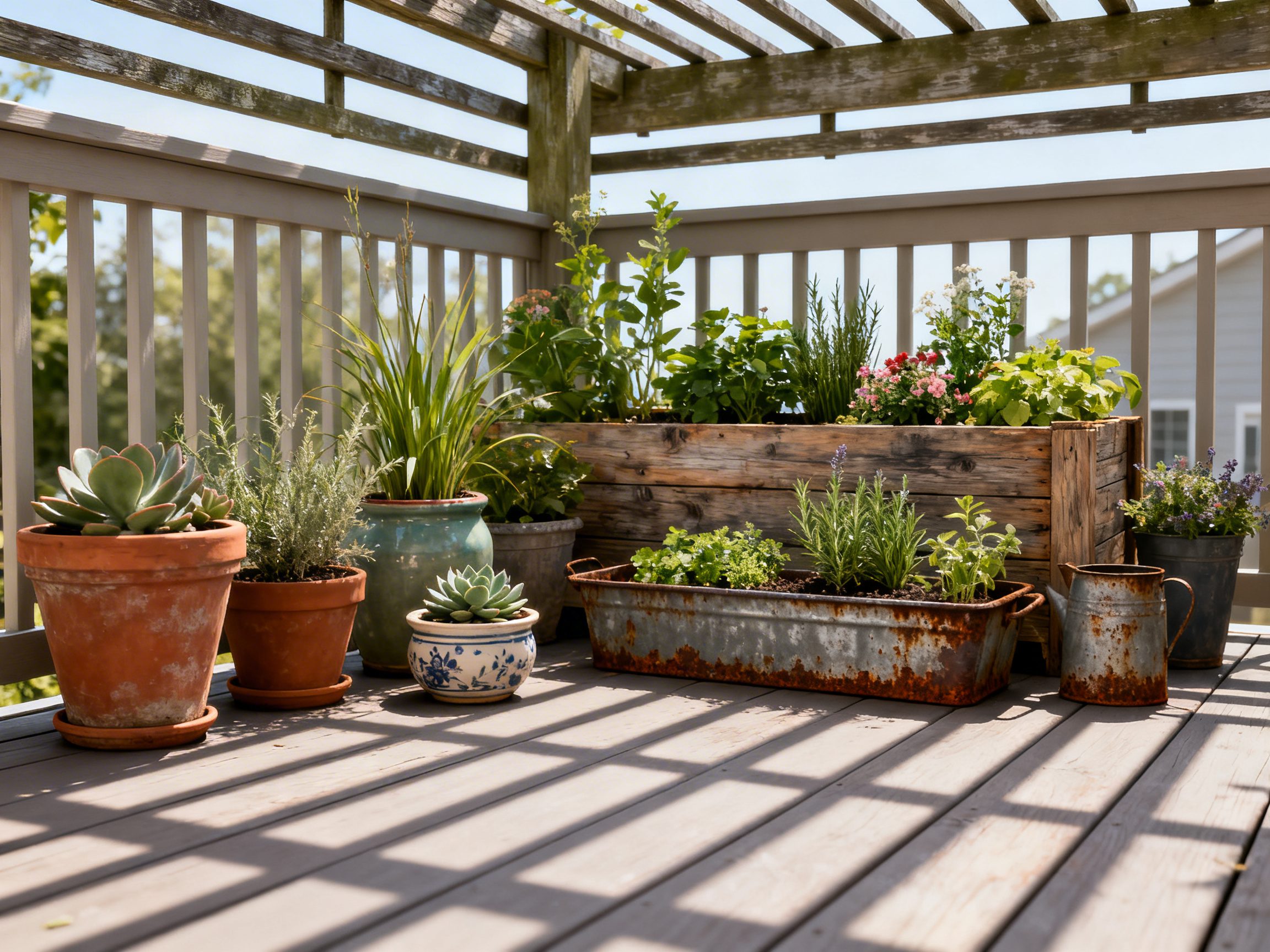
Material matters more on a deck than in a bed
On ground-level decks, the sun reflects off boards and bakes containers from the sides, so temperature swing and weight control your choices.
I consistently reach for double-walled resin, fiberglass, or lightweight concrete blends that buffer roots, hold moisture, and shave off 30 to 60 percent of the weight of true stone. Avoid thin metal in full sun, it scorches roots by mid-afternoon and dries mix too fast unless you sleeve a nursery pot inside.
Scale and proportion set the room
A deck reads as one big rectangle, so you need fewer, larger vessels rather than a scatter of small pots. I aim for 18 to 24 inch diameter for perimeter anchors and 12 to 16 inch for side tables or stair landings.
In my experience, one 22-inch planter flanking seating feels intentional, while three 10-inch pots feel like clutter.
Shapes that steer movement and sightlines
Tapered rectangles slide tight to railings and save floor space, while wide, low bowls calm a coffee table vignette.
Tall cylinders lift foliage above chair backs, so you see green while seated, a small luxury that makes decks feel finished. Reserve one dramatic form, like a ribbed urn, as a focal point near the main entry point to cue flow.
| Poor in full sun without a liner | Avg. Weight (24 in pot) | Heat Performance | Durability | Best Use | Budget Guide (USD) |
|---|---|---|---|---|---|
| Fiberglass | 12–18 lb | Excellent, double-walled options insulate | High, UV stable if quality brand | Large anchors, modern profiles | 160–350 |
| Resin/Poly | 8–15 lb | Good, varies by wall thickness | Medium to High | Budget-friendly sets, rail planters | 60–180 |
| Lightweight Concrete Blend | 25–40 lb | Very good thermal mass | High, chip resistant | Statement pieces, neutral textures | 180–420 |
| Ceramic/Glazed | 35–60 lb | Good, but heavy | Medium, risk of cracking in freeze | Accent color moments, sheltered spots | 120–380 |
| Metal (Powder-coated) | 18–30 lb | Poor in full sun without liner | High if coated well | Shade zones, modern silhouettes | 140–300 |
Finish and palette that tie back to your interior
Pick two finishes, then repeat them: for example, matte charcoal plus warm putty, or textured off-white plus soft sage.
This echoes how you might layer neutrals in a living room or how tonal pottery pairs with natural linens in a Boho Cottage Decor scheme. A restrained palette lets foliage and blooms do the talking without visual noise.
- Choose at least one 18–24-inch pot per 4 linear feet of railing for visual weight.
- Prioritize double-walled or insulated pots in full-sun decks to protect roots.
- Test sightlines seated and standing before final placement, then mark footprints with painter’s tape.
Weight, Drainage, and Protecting Deck Surfaces
Know your load before you fall in love with a planter
Ground-level does not mean infinite capacity. Most residential decks handle 40 to 60 pounds per square foot live load, but concentrated loads from heavy pots can overstrain a joist bay.
I distribute large planters over joists, not between them, and keep individual containers under 120 pounds wet unless a contractor confirms the structure.
Do the math once, buy right once
Wet soil roughly doubles the dry weight, and saturated 24-inch containers often hit 90 to 130 pounds fast. I use a simple formula: container weight plus potting mix volume times 0.6 pounds per quart plus water adds about 8 to 15 pounds for a deep soak.
When in doubt, step down one size or change to fiberglass to hold the same volume with less structural penalty.
Drainage that keeps plants happy and decks safe
Every pot needs large unobstructed drain holes, ideally elevated on 0.5-inch risers to keep runoff moving and prevent tannin stains.
Skip gravel layers; they cause perched water tables. Use a high-porosity potting mix with 20 to 30 percent pine bark or perlite for oxygen in the root zone.
For irrigation, I favor slow-release drippers at 0.5 gallons per hour tied to a battery timer so water never sheets across boards.
Protect finishes like you mean it
I continually see clients place pots directly on composite or cedar, then call me about halos and mold. Install rigid saucers with sidewall clearance or deck trays with channels so any overflow vents away, and always add breathable rubber feet.
For high-traffic edges, a narrow aluminum threshold strip under planters takes scuffs instead of your boards and virtually disappears visually.
| Protection Method | Best For | Pros | Watch-outs | Approx. Cost |
|---|---|---|---|---|
| Pot Risers/Feet | All planters, wood or composite | Airflow, prevents rings, cheap | Can shift on sloped decks, level carefully | $6–$15 per pot |
| Rigid Saucers with Channels | Large pots near seating | Captures drips, easy to clean | Do not oversize, stagnant water risk | $12–$28 per pot |
| Deck Trays/Mat Systems | Grouped planters | Distributes weight, unified look | Measure to fit between boards and rails | $40–$120 per area |
| Drip Irrigation + Timer | Full sun, travel schedules | Even moisture, less runoff | Winterize to avoid splits | $60–$140 per zone |
- Place large planters directly over joists, and verify spacing from below if accessible.
- Elevate every container at least 0.5 inches for airflow and clean runoff.
- Program drippers for early morning, then adjust seasonally by sun and wind.
Designing Wind- and Sun-Smart Plant Combos
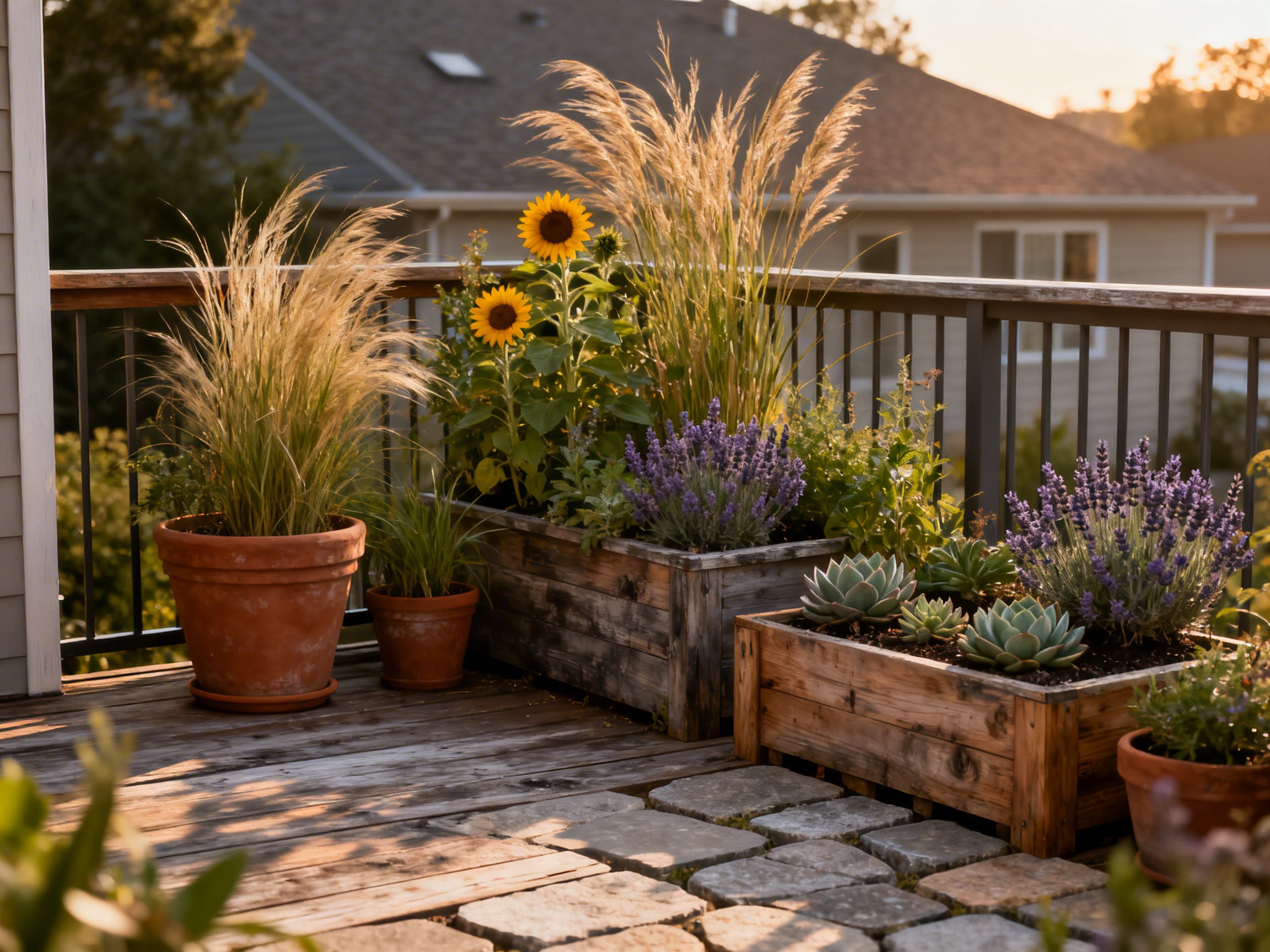
Start with your microclimate, not a mood board
Ground-level decks can be brutal at 2 to 4 pm as heat radiates from boards and adjacent walls. I read the sun window with a phone compass, then choose root-tolerant, drought-resilient plants for west exposures and lusher foliage only where shade persists after noon. Wind funneled along fences can snap tall stems, so I avoid top-heavy combos unless the pot is wide and weighted.
Layer by role: thriller, filler, spiller with performance tweaks
The classic formula works, but I bias the “filler” toward drought-tolerant structure and hold blooms for strategic pops.
For baking decks, I love a spine of dwarf olive, rosemary, or phormium as the thriller, with heliotrope or lantana for color, and trailing dichondra or vinca for the spill. In partial shade, swap to fatsia or hydrangea paniculata dwarfs, with coleus and ivy for texture.
| Exposure | Thriller | Filler | Spiller | Water Needs | Notes |
|---|---|---|---|---|---|
| Full Sun, Windy | Dwarf olive, phormium, compact bay | Rosemary, lantana, angelonia | Dichondra ‘Silver Falls’, trailing portulaca | Low to Moderate | Choose heavier pots or add 2–3 lb gravel base |
| Full Sun, Sheltered | Standard rose, dwarf citrus | Pelargonium, verbena | Sweet potato vine, bacopa | Moderate | Fertilize lightly every 3–4 weeks |
| Part Shade | Fatsia, hydrangea paniculata dwarf | Coleus, heuchera | English ivy, creeping jenny | Moderate | Protect from midday scorch |
| Morning Sun, Afternoon Shade | Camellia sasanqua dwarf | Impatiens New Guinea, begonias | Tradescantia, variegated plectranthus | Moderate | Good near seating for fragrance and color |
| Edible Focus | Espalier apple on trellis | Thyme, basil, chives | Strawberry, trailing oregano | Moderate | Use food-safe liners, rotate crops seasonally |
Stability, staking, and right-size roots
Wind is less about gusts and more about leverage. I plant tall elements off-center, slightly leaning into the prevailing wind, and bury 2 to 3 inches deeper for immediate grip.
For top-heavies like standard roses, a discrete fiberglass stake tied low keeps canes upright without shouting.
Irrigation and soil mix tuned for heat
On hot decks, I cut potting mix with 15 percent pumice or coarse perlite plus 10 percent coco coir for water retention without compaction.
Then I run 0.5-gallon-per-hour emitters, one per 10 to 12 inches of pot diameter, on a 15 to 25 minute morning cycle, increasing during heat waves.
A slow-release organic fertilizer at planting gives 8 to 10 weeks of steady growth with fewer flushes and less legginess.
- Test wind by placing an empty pot for a day, then note scuff or movement before final layout.
- Group pots with similar sun and water needs to simplify irrigation zones.
- Echo foliage tones used indoors, like the herbaceous greens from Cottage Bedding Ideas textiles, for a cohesive in-out read.
Low-Maintenance Plant Palettes for Busy Weeks
Climate-smart mixes that still look lush
When a client tells me they travel often, I reach for drought-tolerant pairings that hold shape and color with minimal fuss.
Think structural evergreens like dwarf boxwood or rosemary as anchors, then layer long-bloomers such as calibrachoa and verbena for color continuity.
In hot zones, add silver foliage like Helichrysum or lavender to reflect light and reduce stress, which buys you a few extra days between waterings.
Soil, pot size, and the right root habits
The fastest way to make a plant “high maintenance” is an undersized pot and peaty soil that swings from soggy to bone dry. I specify a chunky container mix with 20 to 30 percent pine bark, plus 10 percent perlite for air flow, and use at least 14 to 18-inch diameter pots for summer containers.
Favor plants with fibrous or shallow roots that play well in pots, for example, sedums, dwarf grasses like ‘Hameln’ pennisetum, and compact arbutus or myrtle in large vessels.
Palettes I specify again and again
- Coastal heat: Rosemary ‘Tuscan Blue’, trailing portulaca, silver dichondra, and blue fescue for cool contrast.
- Temperate shade: Hosta ‘Guacamole’, heuchera ‘Caramel’, trailing ivy, and a dwarf Japanese holly for bones.
- Sun with pollinator pull: Salvia ‘Mystic Spires’, lantana ‘New Gold’, sweet potato vine ‘Margarita’, and dwarf fountain grass.
Fertilizer and pruning cadence that saves time
Slow-release fertilizer at planting saves weekly chores, then a light liquid feed every three weeks during peak bloom keeps annuals consistent.
I deadhead in one sweep every other weekend, trimming back any leggy trailers by one third to reset shape. Choose self-cleaning bloomers like calibrachoa or some newer petunias if you know you will skip deadheading.
| Palette | Sun/Shade | Water Frequency (summer) | Container Size | Maintenance Notes |
|---|---|---|---|---|
| Coastal heat | Full sun | 2–3x/week | 18–22 in | Drought tolerant, trim rosemary quarterly |
| Temperate shade | Partial shade | 1–2x/week | 16–20 in | Slug control, split hosta leaves if crowded |
| Pollinator sun | Full sun | 2–3x/week | 18–22 in | Cut salvia after first flush for rebloom |
Irrigation Options for Containers on Decking
Match the system to the deck material and pot, count
On ground-level decks, I avoid anything that pools water near joists. For under 6 pots, a clever hose-end timer with a single 1/2 inch poly header and drip stakes is affordable and tidy.
Over 8 pots, step up to a manifold with pressure regulation and 1 gph emitters, so each container receives measured flow without oversaturating the deck.
Protect the structure with smart routing
I route the main line along the inner rim of the deck, clip every 18 inches, and cross boards at seams using low-profile saddles, never screwing through waterproof membranes.
Use saucers with riser feet or capillary mats so runoff never sits against wood. In my experience, placing lines behind planters and painting them to match the fascia makes the system visually disappear.
Seasonal control and redundancy
Use a Wi‑Fi timer with a rain skip and soil moisture input for real control during heat waves. I also pair a backflow preventer at the spigot with a 25 psi regulator to keep emitters consistent.
Before travel, run a five-minute test cycle and stick your finger two inches into the mix of each pot, adjusting any that feel wetter or drier than neighbors.
| Option | Best For | Approx. Cost | Pros | Watch-outs |
|---|---|---|---|---|
| Self-watering inserts | 1–4 large planters | $25–$60 each | No tubing, great for travel | Heavier pots, clean reservoirs monthly |
| Hose timer + drip stakes | 4–10 mixed pots | $80–$180 | Scalable, discreet | Winterize lines, check clogs |
| Manifold system with zones | 10+ pots, sun/shade zones | $200–$500 | Precise control per group | More setup time, pressure balancing |
Deck-friendly drip details
Choose 1 gph emitters for 14–18 inch pots and 2 gph for anything over 20 inches in summer. Place two emitters opposite each other in large planters to wet the full root ball.
Add quick-connects at the spigot so you can detach and coil lines for winter without wrestling the entire header.
For broader outdoor styling synergy, study the balance of timber tones and soft textures used in Boho Cottage Decor guide, then echo those palettes in your container finishes.
Layout Strategies for Traffic Flow and Views
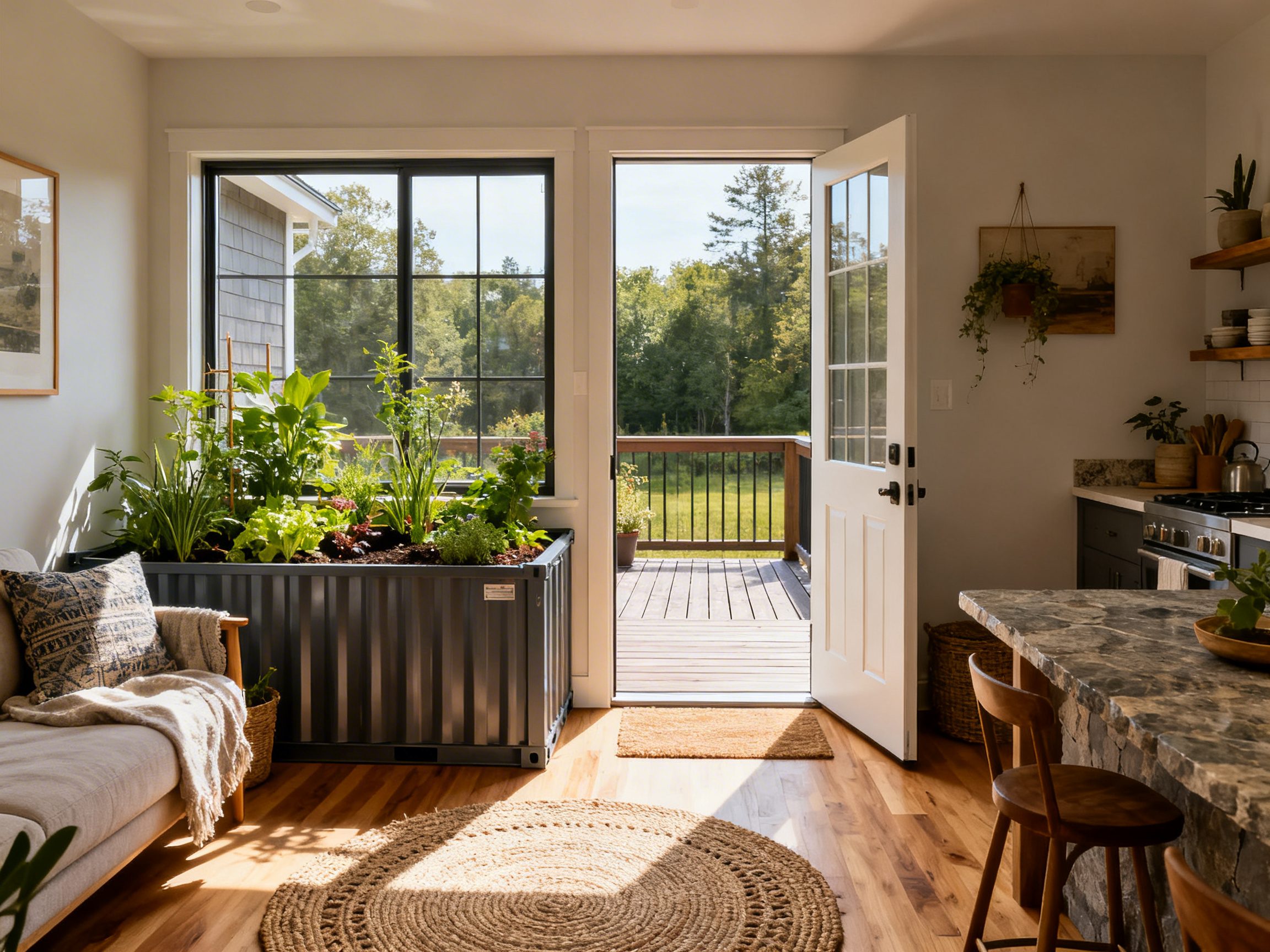
Anchor points first, then infill
Start by placing the heaviest containers at structural corners or where the deck meets the yard, which frames the perimeter and keeps walkways clear.
I aim for a 36-inch clear path from the door to seating, then allow gentle pinches to 30 inches where a pot can create a soft “shoulder.” After anchors, nest medium planters in pairs, then finish with low bowls to blur hard edges without tripping feet.
Sightlines from indoors and seated height
Stand inside at your main viewing window, and place a tall statement planter where your eye lands within the first third of the deck. When seated, any planter within 24 inches of a chair should top out around 18 to 24 inches so it never blocks conversation.
Use staggered heights, for example, 12-inch bowls in front, 18-inch cylinders mid, and 24 to 30-inch towers at the back, to create depth without a wall effect.
Microclimate zoning that looks intentional
Group sun lovers on the south or west rail and keep shade-tolerant containers near the house wall where eaves cast shade. On windy exposures, choose squat, wide bases and add 20 percent gravel to the bottom third for ballast.
I consistently avoid tall top-heavy forms on narrow stairs, and instead run a linear trough against the stringer for green without snags.
| Zone | Recommended Heights | Clearance Target | Container Form | Notes |
|---|---|---|---|---|
| Main walkway | 12–18 in | 36 in | Low bowls, rectangles | Round edges to prevent scuffs |
| Perimeter corners | 24–30 in | N/A | Tapered towers | Great for evergreens or grasses |
| Seating cluster | 18–24 in | 24 in around chairs | Cylinders, squat rounds | Fragrance plants near noses |
If your deck opens to a kitchen, echo the clean lines and pale tones from our White Farmhouse Kitchen piece for continuity between indoors and out.
Cold, Heat, and Overwintering on the Deck
Thermal Reality on Ground-Level Decks
Decks run hotter by day and colder by night than beds, since air moves under boards and reflected heat bounces off siding and pavers. In my experience, black composite surfaces push pot root zones 10 to 20 degrees warmer on peak afternoons, then swing down fast after sunset.
Choose containers with insulating walls and elevate pots on feet to slow heat transfer through the decking.
Plant Choices by Temperature Tolerance
Match plants to the deck’s microclimate, not just your USDA Zone. Hot, west-facing decks suit Mediterranean herbs, dwarf olives, rosemary, and lantana, while morning-sun decks can handle hydrangea, ferns, and begonias.
For shoulder seasons, I rely on evergreen boxwood, bay laurel, and dwarf conifers in larger vessels, which buffer roots from swings and carry structure through winter.
Container Materials and Insulation
Material is the quiet hero. In practice, double-walled resin and thick fiber cement outperform thin terracotta on both heat and freeze, while metal heats fastest unless lined.
If you already own lightweight pots, drop a plastic nursery pot inside and back-fill the cavity with dry bark or rigid foam to create an insulating sleeve.
| Material | Heat Behavior | Freeze Behavior | Best Use |
|---|---|---|---|
| Terracotta | Breathes, dries fast | Cracks if saturated and frozen | Arid-loving plants, bring in for hard freezes |
| Glazed Ceramic | Moderate heat gain | Better freeze resistance, heavy | Statement pots, stable in wind |
| Fiber Cement | Stable temps, slower drying | Good freeze-thaw durability | Year-round planters on deck |
| Double-walled Resin | Insulated, light | Excellent freeze performance | Large volume, easy to move |
| Metal | Heats quickly | No crack risk, but root cold | Use liners and shade in summer |
Watering, Mulch, and Evaporation Control
On hot decks, water stress is the plant killer. I top-dress with 1 to 2 inches of fine pine bark or pea gravel to slow evaporation, and I group containers so foliage shades pot walls.
If you are away often, a simple drip line on a battery timer keeps soil stable and prevents the daily wilt cycle that weakens roots.
Overwintering Strategy That Actually Works
The key is root-zone survival, not pretty tops. Cluster pots against a wind-sheltered wall, wrap the group with breathable frost cloth, then stuff leaves or straw between pots for insulation.
For borderline-hardy plants, slide the nursery liner out of its decorative shell and overwinter in an unheated garage where temperatures stay 25 to 45 degrees, watering once a month.
Drainage and Freeze-Thaw Safety
Water expands when it freezes, so saturated soil and blocked drain holes equal shattered pots. I raise every container on 1-inch feet, add a coarse drainage layer only if the pot is very tall, and use a peat-free, bark-based mix that drains fast yet holds air.
Meanwhile, tilt saucers off in winter, or better, remove them entirely to avoid ice locks.
Sun, Shade, and Surface Protection
UV and radiant heat can scorch foliage and warp deck boards under heavy, wet pots. I place heat-sensitive plants where they catch dappled afternoon shade and slip breathable pot coasters under large planters to spread weight and prevent moisture rings.
If you love a dark pot, paint the sun side in a lighter tone on the interior or wrap with reed screen to cool roots without changing the look.
Budget Breakdown: Pots, Soil, and Upkeep
Where the Money Actually Goes
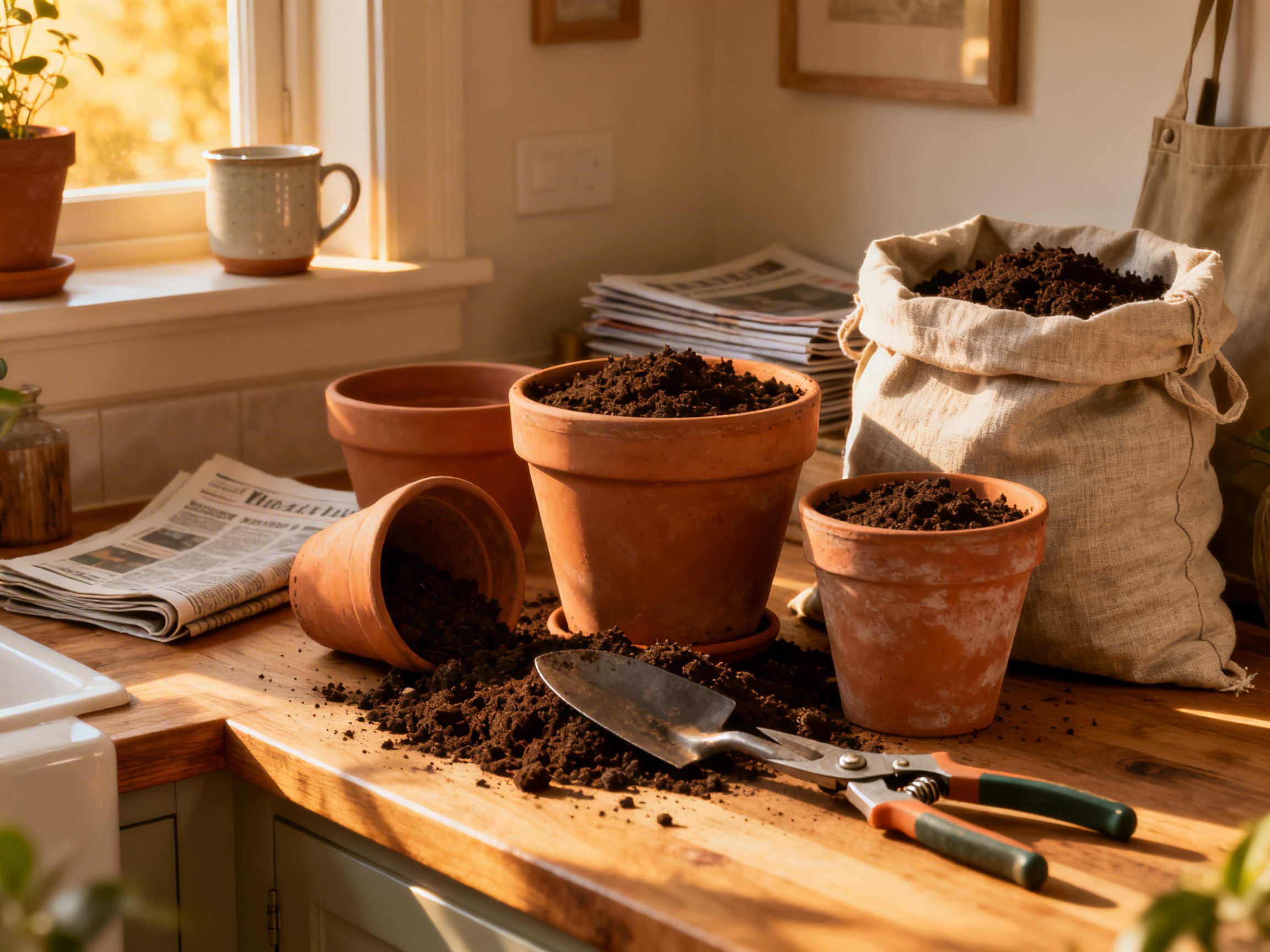
Most first-timers overspend on plants and underspend on soil and pot size. In my projects, 50 to 60 percent of the budget goes to quality planters and soil, because that determines long-term success and replacement costs. Expect ongoing upkeep to be modest if you invest in the right foundation.
| Line Item | Entry Budget Deck | Midrange Deck | Premium Deck | Notes |
|---|---|---|---|---|
| Planters (4 to 8) | $120–$300 | $400–$900 | $1,200–$3,000 | Resin at entry, fiber cement mid, large ceramic premium |
| Soil & Amendments | $60–$120 | $150–$300 | $300–$600 | Peat-free mixes, bark perlite, slow-release fertilizer |
| Plants | $100–$250 | $300–$700 | $800–$1,800 | Mix thrillers, fillers, spillers, plus evergreen anchors |
| Irrigation/Watering | $25–$60 | $80–$200 | $300–$700 | From hose timers to buried manifolds and quick-connects |
| Accessories/Feet/Saucers | $20–$50 | $60–$120 | $150–$300 | Protects deck, improves drainage |
| Annual Upkeep | $60–$120 | $120–$250 | $250–$500 | Fertilizer, replacement plants, mulch, drip repairs |
What to Prioritize to Save Over Time
Bigger, fewer pots cost more upfront but reduce plant loss and watering, which saves money by year two. I also prioritize peat-free, bark-based mixes that do not collapse in six months, so you top up rather than replace.
Where the budget is tight, select perennial structure plants, then rotate seasonal color in a few satellite inserts.
Smart Sourcing and Mixing
Match container scale to deck size to avoid overbuying: on a small ground-level deck, two 20 to 24-inch planters and three 14 to 16-inch companions usually balance doors and railings. I often blend a bulk professional mix with fine bark at a 3:1 ratio, then add a slow-release fertilizer to stretch feeding for 4 to 6 months. Skip gravel-filled bottoms that waste volume; instead, use an internal false bottom insert for tall pots and less soil.
Running Costs and Time
With a basic drip line and mulch, watering drops to minutes a week, even in heat spikes. Plan for fertilizer two to three times per season, plus a light replant in spring for annual color.
If you overwinter correctly, evergreen anchors last for years, which shifts spending from replacement to occasional refresh.
Budget Examples You Can Copy
- Entry setup, 5 pots: two 22-inch resin cylinders, three 14-inch planters, 6 bags of mix, 1 hose timer, drought-tolerant palette. Target $350 to $550.
- Midrange setup, 7 pots: fiber cement mix of 18 to 30 inches, drip kit with 1/4 inch line and pressure reducer, evergreen cores plus seasonal change-outs. Target $900 to $1,600.
- Premium setup, 8 to 10 pots: large glazed ceramics, hidden micro-irrigation, specimen conifers or olives, underplanting with perennials. Target $2,500 to $5,000.
A useful follow-up is 13 Earthy Bedroom Accent Ideas Using Terracotta Painted Pots.
FAQ
Aim for at least 16 inches in diameter for annuals and 20 to 24 inches for shrubs or small trees. Larger volumes buffer heat, reduce watering, and improve winter survival.
Yes, if they are freeze-thaw resistant, elevated on feet, and planted with hardy species for your zone. Group, wrap with frost cloth, and remove saucers to prevent ice damage.
Use a peat-free, bark-based mix with perlite for drainage and long-term structure. Avoid garden soil, which compacts and suffocates roots in containers.
Use breathable risers or low-profile coasters to distribute weight and keep moisture off boards. Check that drainage runs away from joints and re-seal wood as needed.
Final Thoughts
Container gardens thrive on decks when you control temperature swings, size pots correctly, and invest in durable materials and mix. Spend smart on the foundation, then edit plants seasonally for impact with minimal upkeep. This is how you get resort-level greenery steps from your door, year after year.